Scuba diving in Montenegro: prices, sites, first dive
Updated:
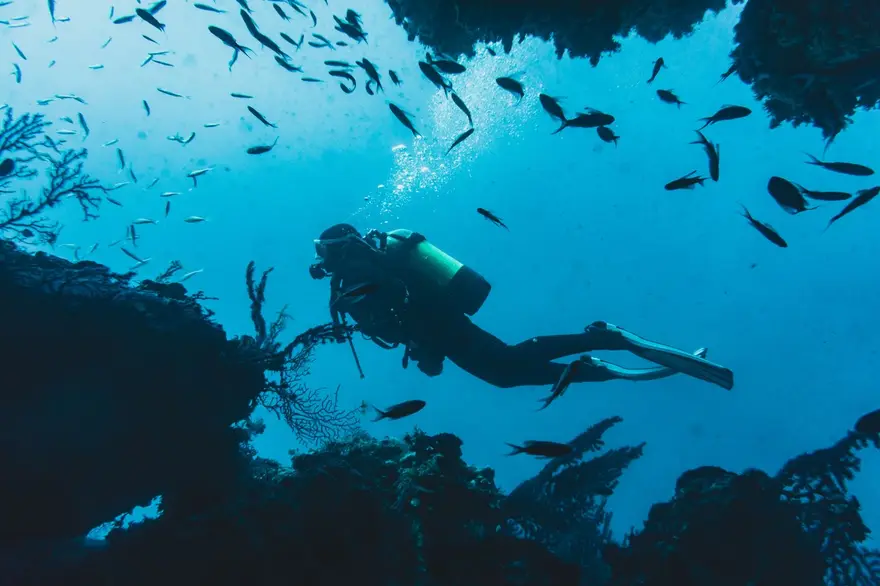
The Adriatic off the Montenegrin coast is some of the clearest water in Europe: on a calm day you can see for tens of metres underwater. Below the surface: rock walls, grottoes, shoals of fish and ships that have been down there since the two world wars.
The thing worth knowing first: you do not need a certification to dive here. A first dive with an instructor costs from €69 and is open to any healthy person over ten. Below are the other options, where exactly you go in, how the day runs and what to pack.
What it costs
Per person, equipment included:
| Option | Price |
|---|---|
| First dive, no certification, with an instructor | from €69 |
| Single dive for certified divers | from €60 |
| Two dives for certified divers | from €110 |
| Snorkelling: mask, snorkel, fins | from €24 |
| Passenger on the boat, 12 and over | from €14 |
| Children under 12 on the boat | free |
The price covers the boat, a full set of gear, the instructor, masks and snorkels, tea and coffee on board. It does not cover food or transport to Budva: if you are staying in Herceg Novi or Bar, you make your own way to the marina.
Filming is charged separately: 20–30 underwater photographs cost from €10, action-cam video on a memory card from €25. For experienced divers, a tank fill is from €0.70 per litre of capacity and a 12-litre nitrox EAN 32% fill from €15.
Prices are indicative and were checked in September 2026. The exact figure for your dates comes from the company running the dive.
Do you need a certification
No. It is the first question almost everyone asks, and the answer is straightforward: from €69 is the price precisely for people who have never dived. Before the boat leaves, the instructor runs a short briefing — how to breathe through the regulator, how to equalise, how to signal that you are fine. After that you descend paired with them; they keep you in sight throughout and control the depth.
Certified divers, incidentally, also go down with an instructor. That is the dive centre’s rule, not a comment on your card.
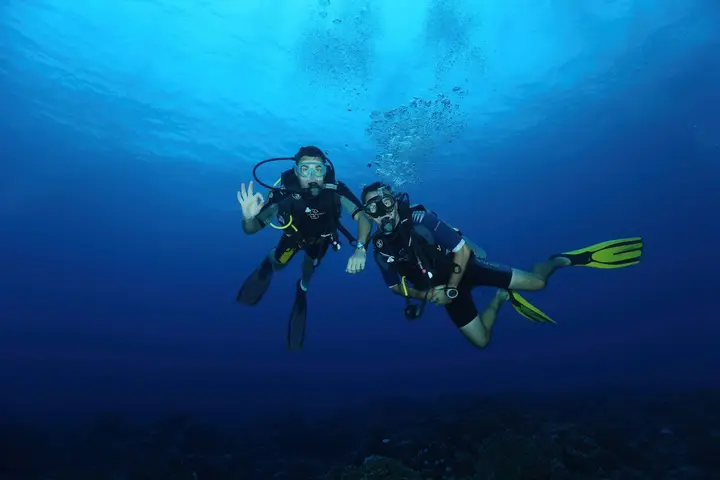
The restrictions are simple: ten years and older, no problems with the heart, lungs or ears. A cold or a blocked nose is a reason to postpone — you will not be able to equalise and your ears will hurt. Skip alcohol for 24 hours before, and do not fly for at least 18–24 hours after a dive. That last one matters if your flight home is on the final day of the holiday.
Where you actually dive
Every departure leaves Budva from the marina by the Old Town. The boat runs ten to fifteen minutes, and there are four main sites:
- The island of Sveti Nikola — locals call it Hawaii. The seaward side has walls dropping away, grottoes and plenty of fish. This is the main site.
- Cape Mogren — just beyond the Budva beaches: rock and underwater clefts.
- Jaz — open water opposite the beach of the same name.
- Platamuni — one of the most interesting sites once you have some dives behind you: a long underwater wall and caves.
When there is swell, boats go to the sheltered side of the island. Departures are rarely cancelled, but a strong wind will do it; check when you book how the dive is rescheduled or refunded if that happens.
A dive lasts 30–45 minutes at six to nine metres. Modest by experienced standards — and exactly the depth where there is still light and colour.
What is down there
The Adriatic is not the tropics: no coral gardens, no parrotfish. What it has instead is what the tropics do not.
Visibility. Jacques-Yves Cousteau is credited with saying he had never seen water clearer than off the coasts of Montenegro and Croatia. On a calm day you can see for tens of metres — at nine metres down you can see the seabed and the surface at once.
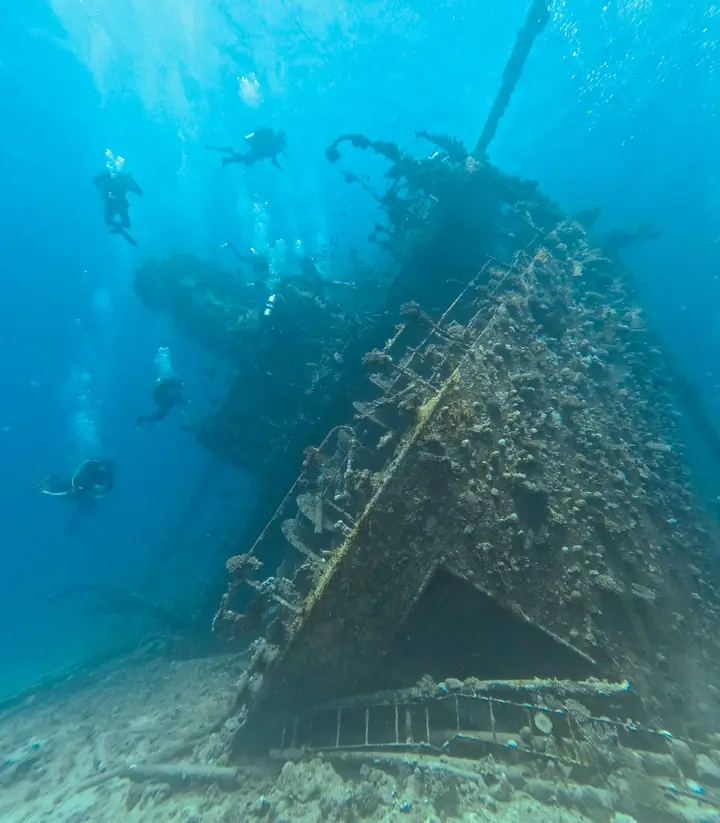
Wrecks. Austro-Hungarian and German vessels sunk in the two world wars lie along the coast and in the Bay of Kotor, along with cargo ships. Most of the deep wrecks are open only to certified divers with experience, but knowing they are there changes how the dive feels.
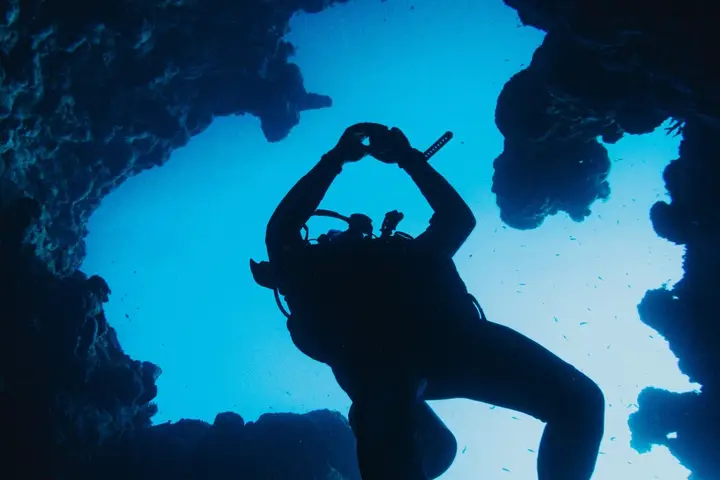
Rock and grottoes. The coastline is cut with underwater caves and clefts, entered with a torch.
Life. Octopus in the crevices, sea urchins, shoals of sea bream and red mullet, the occasional moray. All of it at the depth you will be taken to.
How the day runs
There are two departures, morning and afternoon.
Morning. Meet at 8:45 at the dive centre in Budva; the boat leaves at 9:00. One or two dives at different sites with a break between them for water and rest. Back around 13:00.
Afternoon. Meet at 14:45, out at 15:00, a single dive at Sveti Nikola or Mogren. Back by 18:00.
The boat takes twelve divers and twelve passengers: twelve metres long, three and a half wide, with a toilet, a shower and a sun deck. Tea, coffee and water on board are free.
The meeting point arrives with your booking confirmation as map coordinates. You get there yourself. From Kotor or Tivat the bus is the easy way: more than twenty a day run to Budva, usually €5 and 35–40 minutes. A taxi in season is the most expensive option; if you take one, agree the fare before you get in.
Briefing, dive, surface, rest on deck: four to six hours in total including travel. Do not plan anything demanding for that evening — the sea makes you sleepy.
If you are not diving and are coming with family
This option is often overlooked. You can join the boat without going under at all:
- Snorkelling, from €24 — mask, snorkel and fins, floating near the boat. At six metres the water is clear enough to see the bottom from the surface.
- Passenger, from €14 — you simply come along, swim around the boat and sunbathe on the upper deck.
- Children under 12 travel free.
So a family of four where one person dives pays from €69 for the dive plus from €14 for an adult passenger — children under 12 travel free.
What to bring
- Swimwear, put on in advance under your clothes
- Socks and a T-shirt — worn under the wetsuit, they make it easier to pull on and stop it chafing
- A towel and a dry T-shirt to change into
- Sun cream: there is little shade on deck
- Cash for extras — photos, video, taxi
- Water, though there is tea and coffee on board
Glasses and contacts: lenses do not sit well inside a mask, so take them out. If your prescription is strong, mention it when booking — some centres keep masks with corrective lenses.
When to go
The season runs 1 June to 30 September, with departures every day; there are no dives from October to May. The 2026 season ends on 30 September, and the next one starts in June 2027. The water is 22–24 °C in June, 25–26 °C in July and August and 23–25 °C in September; a wetsuit is comfortable throughout.
The best months are June and September: the sea is already or still warm, the boat is quieter, and visibility is usually better than at the height of August, when boats and swimmers stir everything up. In July and August places go two or three days ahead, especially on the morning departure.
Dives are guided in Russian, English or Serbian — the language is confirmed when you book.
In short
Diving in Montenegro is not about the exotic. It is about clear water and history on the seabed. For a beginner it costs from €69 and half a day, needs no preparation and no paperwork, and is probably one of the strongest impressions available on this coast in a single morning.
Below are the dates and remaining places. Booking and payment go directly to the company running the dive.
Prices checked in September 2026. More active trips in the Adventure section: paragliding over Budva and kayaks and SUP. Everything else — choose a category; group trips with prices by departure town are on the tours in Montenegro page.
Book a dive
Dates, remaining places and prices come from the operator's own system. Booking and payment go directly to them.
Comments
No comments yet — be the first.