Mobile internet in Montenegro: costs and dead zones
Updated:
On a driving holiday the internet is a tool, not a comfort: navigation on the hairpins, finding a petrol station, phoning the rental company when something goes wrong. The good news is that connectivity here is cheap — 500 gigabytes for 15 days costs €15, and that is not a typo.
The bad news is that your British or EU SIM turns into an expensive habit the moment you cross the border, and that in the most beautiful parts of the country there is no signal at all.
Why your European SIM costs so much here
Montenegro is not in the European Union, and “roam like at home” does not work here — neither on EU tariffs nor on British plans that include European roaming. A British, Irish or any other European card will connect, but at roaming rates: some operators sell a daily bundle for a few euros, others simply meter you — and that bill lands after the holiday, when it is too late to argue.
For EU SIM cards this may change: talks on extending “roam like at home” to the Western Balkans have been under way since June 2026. The expected date is the end of 2026 or early 2027; there is no firm deadline.
Until the agreement is signed, the rule is simple: check your own tariff before you fly. If there is no special option for Montenegro, a local SIM or an eSIM pays for itself on day one.
What a local SIM costs
There are three networks: Crnogorski Telekom, One and m:tel. All three sell tourist bundles, and the prices barely differ:
- €15 — 500 GB for 15 days
- €20 — 1 TB for 30 days
- €25–30 — unlimited
Five hundred gigabytes is a marketing figure — nobody gets through that on holiday. Read it as “more data than you will use” and stop thinking about volume.
Also check how much roaming across the neighbours comes inside the bundle: it is 9–20 GB for the Western Balkans — Serbia, Bosnia and Herzegovina, North Macedonia, Albania, Kosovo. If a day in Trebinje or a run to Shkodër is on the plan, that saves you juggling a second card at the border.
One more reason to go local: paying for parking by SMS only works with a Montenegrin SIM card. Details in parking in Montenegro.
Domestic calls are usually included, though you will hardly need them: everything with rental companies and tour operators happens in messengers.
Where to buy one and what you need
At a tobacco kiosk. The most common place, and the one tourists tend to miss. Small booths marked Duvan stand on every promenade, by bus stations and markets; SIMs sit there next to cigarettes, water and parking tokens. They open longer than phone shops, often seven days a week, and there is no queue. You can top up there later too — give the number and the amount.
At the airport. Both Tivat and Podgorica have operator desks in arrivals. The fastest option: a card in your hand five minutes after the baggage belt, at the same price as in town.
In a phone shop or supermarket. Budva, Kotor, Bar and Herceg Novi have shops from all three operators on the main streets, open late in season. Large supermarkets keep SIMs at the till.
What you need: your passport. Tourist cards are registered to the bearer, and without registration the SIM will not activate — that is the law, not the salesman being difficult. Activation takes a few minutes and the data works straight away.
What you do not need: a local address, a bank card or a residence permit.
One piece of practical advice: buy the SIM on day one, not “when I need it”. You will need it exactly when you are on a mountain road with no map and no signal — that is, at the moment when buying one is no longer possible.
When an eSIM makes more sense
If your phone supports eSIM, you can buy the profile in advance and switch it on in the aircraft. By the time you walk out of arrivals the internet already works and there is no desk to find.
All three local operators issue eSIMs. Buying online means proving who you are: a passport scan and a selfie, with checks taking anywhere from minutes to an hour.
There are also international eSIM services with regional plans, where one profile covers several Balkan countries. That is convenient when Montenegro is one leg of a longer route through Croatia and Albania.
The eSIM has one drawback — the price per gigabyte. International plans typically give you 5–20 GB for the money a local operator charges for “unlimited”. Over a week the gap is small; over a month it is obvious.
A simple rule: one country and more than a week — buy local. Several countries or a short trip — eSIM.
Which operator to choose
The honest answer: you will not notice the difference. Coverage along the coast is comparable across all three, and the speed is more than enough.
5G exists here and is not a formality: the network launched in March 2022 and now covers around 96% of the population. In Podgorica, Kotor and Budva it works confidently. For maps that is overkill, but if you plan to work from the holiday, the speed is there.
If you must choose: compare how much neighbouring-country roaming each bundle includes — it ranges from 9 to 20 GB. Crnogorski Telekom has historically had slightly better reach deep in the mountains.
Where the signal disappears
Along the coast the connection is solid everywhere, from Herceg Novi to Ulcinj. Trouble starts precisely where the interesting roads start:
- The Lovćen serpentine. The signal drops on some of the hairpins, especially where the rock shields you. It returns at the viewpoints.
- The Tara canyon. Deep in the canyon there is nothing at all, on any network. Up on the Durmitor plateau and in Žabljak you are back online.
- The road around Lake Skadar. Patchy, particularly on the dirt turn-offs down to the water.
- The Sozina tunnel. No signal inside — normal for a tunnel that long.
- Northern mountain villages. Coverage in the villages, gaps between them.
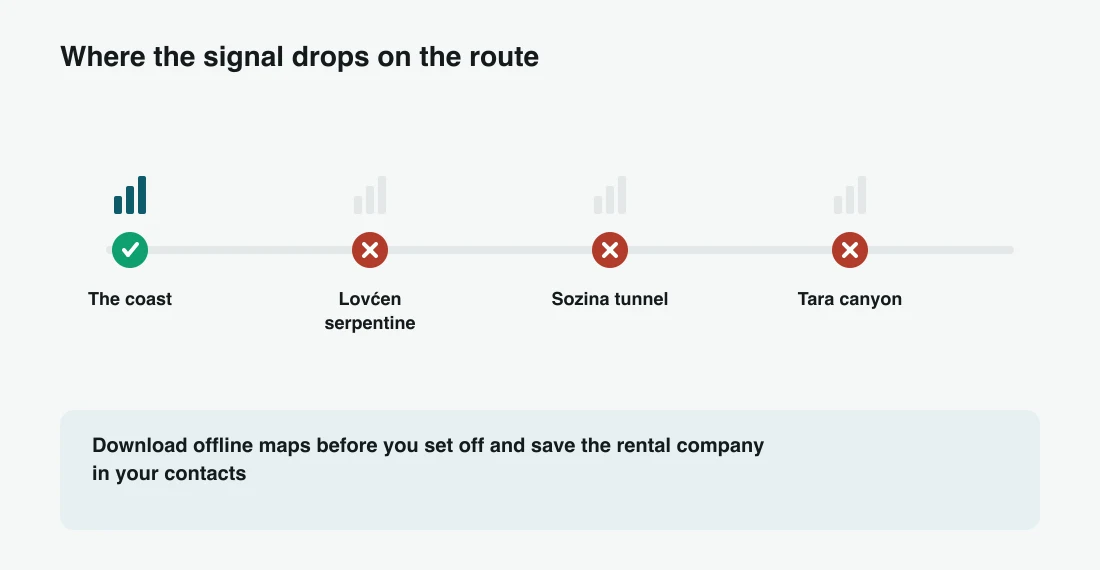
Worth separating: navigation works offline, search does not. A map downloaded to the phone will guide you round any hairpin with no signal at all. But “nearest petrol station” or “open now” needs data — and that is exactly what you tend to want in the mountains.
Wi-Fi
Hotels, apartments, cafés and restaurants have Wi-Fi almost everywhere and almost always free — ask the waiter for the password or find it printed on the receipt. The speed handles a video call.
Free municipal networks exist on the promenades of Budva and Kotor, but do not count on them: in season they are saturated. And Wi-Fi is no substitute for a SIM, because it fails you exactly where you need it — on the road.
Do this before you go
Download offline maps. This is the single most useful line in this article. Select the whole of Montenegro; the country is small and the package is light. Do it at home on your own Wi-Fi, not at the airport.
Save the rental company’s phone number in your contacts, not just in the booking email, and note the registration plate. Hunting through an inbox without data on a mountain road is hopeless.
Remember 112. The single emergency number works from any SIM, even with no credit and no active plan — as everywhere in Europe.
Bring a car charger. Navigation eats the battery faster than you expect and a day behind the wheel is long. Rental cars do not always have a phone holder; on a long trip, bring your own.
In short
Buy a local SIM at the airport on arrival day: €15 for 15 days and 500 GB, which is more than enough. Passport in hand, five minutes to activate. If your phone takes an eSIM and the route crosses borders, look at a regional profile instead. And download the offline maps while you are still at home — in the Tara canyon they are the only thing that will work.
Prices checked in September 2026. Also useful behind the wheel: driving rules, parking, fuel and a five-day route. A car for that route can be picked on the car rental page.
Comments
No comments yet — be the first.