Turkey toll roads, HGS and fines: a 2026 guide
Updated:
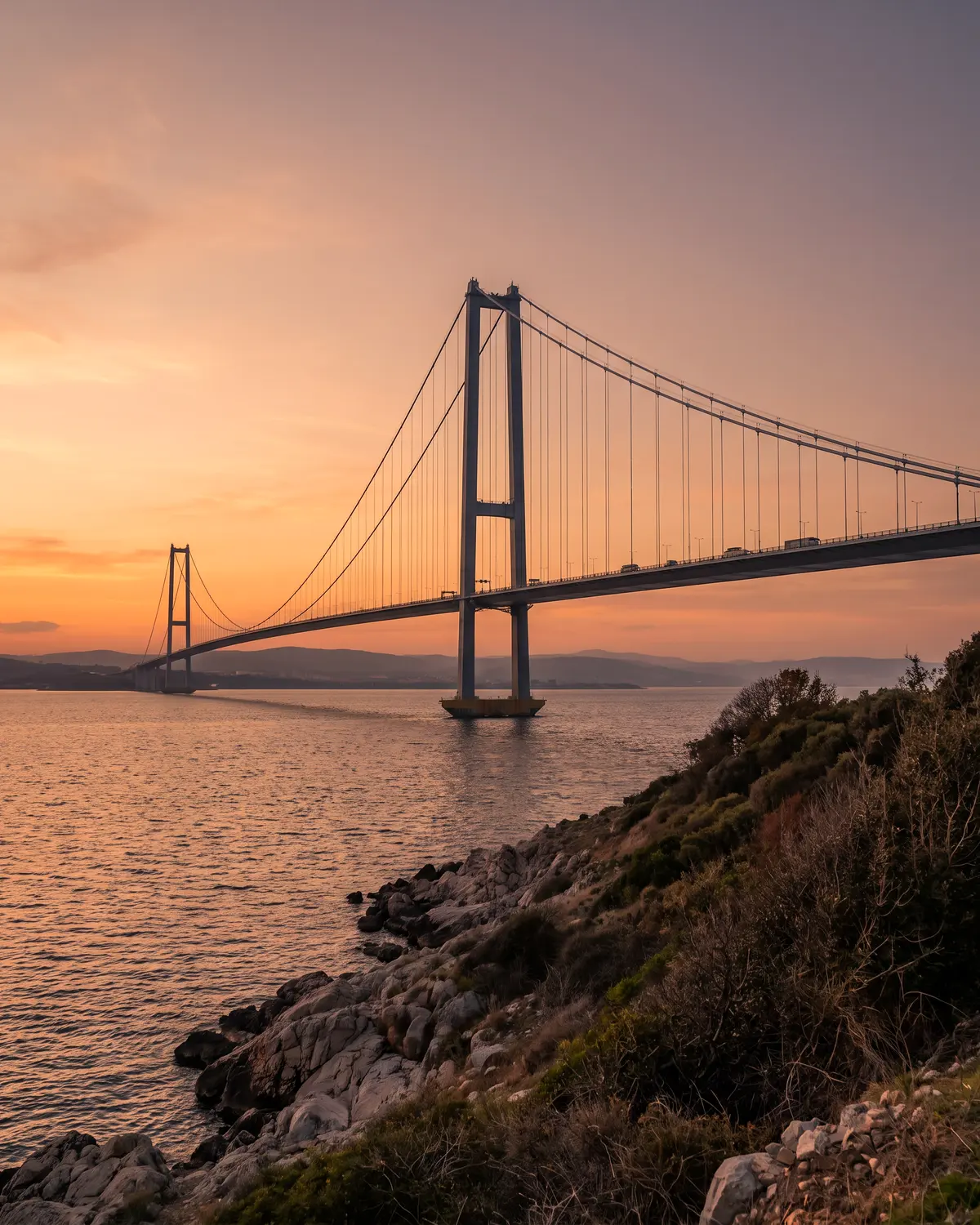 Image generated by AI
This guide was prepared by AI from official sources as of the date shown. Rules change, so check the official website before you travel.
Motorways, the Bosphorus and Dardanelles bridges and the Eurasia Tunnel are all tolled in Turkey. You pay automatically through an HGS sticker on the car. Almost every hire car has one, but ask the company to activate it. The total comes out of your deposit when you return the car, along with an administration fee.
A Bosphorus bridge costs around €1–2 (59–110 lira), while the Osmangazi or Çanakkale bridge costs around €21 (1,170 lira). Prices are as of 1 November 2026. Turkey has no vignettes, and the D400 coast road is free.
Speed limits are 50 km/h in town, 90 km/h outside town and 120 km/h on motorways. Fines rose sharply in 2026: 5,000 lira (about €90) for holding a phone at the wheel, and 25,000 lira (about €450) plus a driving ban for drink-driving. Pay within a month and you get 25% off. The euro figures below use the late October 2026 exchange rate of about 55–56 lira to the euro.
If you normally drive on the left, the basics first: traffic in Turkey drives on the right, and you may overtake only on the left.
What is tolled and what is free?
Tolls apply on motorways (otoyol) between major cities and on some bridges and tunnels. There is no free way across the Bosphorus: you take a toll bridge or the tunnel. There are usually no barriers, and you drive through the gates without stopping.
Most roads around the resorts are free. This matters if you are hiring in the south, because you can drive from Antalya to Dalaman on the D400 without touching a motorway. The one catch on this stretch is the Göcek Tunnel between Dalaman and Fethiye. It is tolled, and the old road over the pass runs alongside it.
How does HGS work on a hire car?
The system reads an HGS sticker, an OGS transponder or the number plate. You need to drive through the gate for your system. In a hire car, the routine is:
- Before pick-up, tell the agent you will be using toll roads, and ask for the sticker to be activated.
- Drive as normal. There is no need to stop.
- When you return the car, the company checks the bill and deducts the total from your deposit, plus an administration fee.
A red light at the gate does not mean you have to stop. The amount owed can be paid within 15 days with no fine. If the car has no HGS, you can pay it yourself on the website of the General Directorate of Highways (KGM), but in a hire car ring the company first: the number is on your voucher.
From day 16 to day 45 a penalty of one more toll is added, and after day 45 the penalty is four times the toll (Law No. 6001, Article 30). On a hire car, an unpaid toll will find its way back to you through the company.
Some roads have “NAKİT” (cash) and “K.KARTI” (card) lanes. You cannot pay by cash or card at the Eurasia Tunnel gates: it takes HGS, or payment on the operator’s website or app. Keep some small lira notes in the car just in case, but count on using HGS.
How much are the bridges, tunnels and motorways?
Tariffs for a class 1 car, one way, as of 1 November 2026:
| Crossing or road | Lira | Approx. euros |
|---|---|---|
| 15 July and Fatih Sultan Mehmet bridges, Istanbul | 59 | €1 |
| Yavuz Sultan Selim Bridge, Istanbul | 110 | €2 |
| Eurasia Tunnel, daytime | 330 | €6 |
| Eurasia Tunnel, night, 00:00–04:59 | 165 | €3 |
| Osmangazi Bridge, Gulf of Izmit | 1,170 | €21 |
| 1915 Çanakkale Bridge, Dardanelles | 1,170 | €21 |
| Malkara–Çanakkale motorway with the bridge | 1,480 | €27 |
| Ankara–Niğde | 925 | €17 |
| Istanbul–Izmir with the Osmangazi Bridge | 2,895 | €52 |
| Izmir–Aydın | 73 | €1–2 |
| Izmir–Çeşme, Seferihisar–Çeşme section | 53 | €1 |
These figures come from the tariff tables of the Turkish highways authority (KGM) and the Eurasia Tunnel website. On the Istanbul–Izmir motorway, the 2,895 lira is made up of 1,170 for the Osmangazi Bridge and 1,725 for the road all the way to Izmir, so leaving earlier costs less. The 15 July and Fatih Sultan Mehmet bridges and the Izmir–Aydın and Izmir–Çeşme sections are on the tariff from 1 January 2026, the other bridges and motorways on the tariff from 1 July 2026.
All three Bosphorus bridges charge in each direction: a round trip costs 118 lira on the 15 July and Fatih Sultan Mehmet bridges and 220 lira on the Yavuz Sultan Selim Bridge. Some crossovers and minivans fall into class 2 (wheelbase of 3.2 metres or more). They pay more, and class 2 vehicles are not allowed on the 15 July Bridge.
In Istanbul, at the junctions near the Eurasia Tunnel and the Yavuz Sultan Selim Bridge, navigate by the district names on the signs, such as Taksim and Sultanahmet, and ignore the compass.
What are the speed limits in Turkey?
| Where | Limit |
|---|---|
| In town | 50 km/h |
| Outside town | 90 km/h |
| Motorway | 120 km/h |
| Near a school, “Okul Bölgesi” sign | 30 km/h |
Watch the signs, because on any given stretch they override the general rule. Camera fines go to the owner of the car, who passes them on to the hirer.
How much are traffic fines in 2026?
Law No. 7574 took effect on 27 February 2026. Speeding fines are no longer worked out as a percentage; they now depend on how many km/h you are over the limit. The main penalties, as of 1 November 2026:
| Offence | Lira | Approx. euros |
|---|---|---|
| Speeding by 6–10 km/h in town or 11–15 km/h outside town | 2,000 | €36 |
| Speeding by 46–55 km/h in town or 51–60 km/h outside town | 20,000 and a 30-day ban | €360 |
| Speeding by 66 km/h or more in town, or 71 km/h or more outside town | 30,000 and a 90-day ban | €540 |
| Phone in hand, first offence | 5,000 | €90 |
| Red light, first offence | 5,000 | €90 |
| Seat belt | 2,500 | €45 |
| Alcohol above 0.5 per mille, first offence | 25,000 and a 6-month ban | €450 |
| Refusing an alcohol test | 150,000 and a 5-year ban | €2,700 |
| Parking in a prohibited place | 1,246 | €22 |
How to pay. At a tax office, a post office or a Turkish bank. The 25% discount applies if you pay within a month of being notified. If a fine goes unpaid, the hire company is entitled to recover it, and when you leave or re-enter the country you will have to settle the debt with interest.
Alcohol. The limit is 0.5 per mille, but the sensible choice is not to drink at all. Do not refuse a test: the figure in the table speaks for itself.
What else do the police check?
Seat belts are compulsory for all passengers. Phones must be hands-free. Dipped headlights are needed in poor visibility and in tunnels. Children up to 1.5 metres tall and 36 kg must sit in the back, and those under 135 cm need a child restraint.
Police wear blue uniforms, drive white and blue cars and wait in plain sight. They can stop you without any offence having taken place, for licence checks, alcohol tests or at anti-terrorism checkpoints. Keep your passport and licence within reach, along with your 1968 IDP if you drive on a UK licence.
What is driving in Turkey like?
The roads are good, the markings and signs are clear, and much of it is repeated in English. Local drivers are assertive. They sound the horn for any reason, and usually it means “I’m here”, with no anger behind it. Indicators come late or not at all, drivers overtake on the right and change lanes abruptly. Pedestrians cross wherever they like, and at night the odd car has no lights on. You get used to it within a few hours, but take particular care in the dark, in rain and in snow.
A few words on the signs are useful from day one: DUR means stop, Yavaş means slow down, Park Yapılmaz means no parking, Girişi Olmayan Yol means no entry, and D marks a bus stop where you must not stop. Brown signs point to tourist sites.
Do I need winter tyres? And what does fuel cost?
Winter tyres are compulsory only for commercial vehicles on intercity roads, from 15 November to 15 April. Private cars do not need them. If you are heading into the mountains or to Cappadocia in winter, order the winter package when you book; on the coast, ordinary tyres are usually enough in winter. For the mountains, choose an engine of at least 1.4–1.6 litres and fill up beforehand, because petrol stations are scarce up there.
On 1 November 2026 Petrol Ofisi stations charge around 80–83 lira a litre for petrol (roughly €1.45–1.50) and around 100–103 lira for diesel (roughly €1.80), less in Istanbul and more in Antalya. In Turkey, diesel is the dearer of the two. A 50-litre tank of petrol comes to around 4,000–4,150 lira, or roughly €72–74. Prices change almost every week. At most stations an attendant fills up for you: ask for “Kurşunsuz 95” (unleaded) or “Motorin” (diesel) and say “Dolu depo” for a full tank.
Who can skip all this?
If you are only driving around your resort, you will not need HGS or the bridge table, because most resort roads are free. Istanbul is the opposite: the city itself sits in traffic, and bridges and tunnels come into every trip between the two shores. If your plan is the old city, a car will mostly get in the way.
Two more guides are worth reading before you go: parking in Turkey and insurance and deposits. Hire terms are on the car hire in Turkey page, and the Istanbul page covers the bridges and airport pick-up.
Bridge, tunnel and motorway tariffs, fines and fuel as of 1 November 2026, exchange rate as of 30 October 2026.
Common questions
How do I pay tolls in a hire car in Turkey?
Automatically. Almost every hire car has an HGS sticker, but ask the company to activate it in advance. The total is deducted from your deposit when you return the car, along with a service fee.
How much does it cost to cross the Bosphorus?
The 15 July and Fatih Sultan Mehmet bridges cost 59 lira, about €1, and the Yavuz Sultan Selim Bridge 110 lira, about €2. You pay in each direction. Prices as of 1 November 2026.
What are the speed limits in Turkey?
50 km/h in town, 90 km/h outside town and 120 km/h on motorways, with 30 km/h near schools. Road signs take priority over the general rule.
What is the fine for using a phone while driving in Turkey?
In 2026, holding a phone at the wheel costs 5,000 lira, about €90. You get 25% off if you pay within a month.
What does a red light at a toll gate mean?
It does not mean you have to stop. The amount owed can be paid within 15 days with no fine. In a hire car, let the company know.
Is the D400 coast road free?
Yes, the D400 between Antalya, Fethiye and Dalaman is free, with one exception: the Göcek Tunnel between Dalaman and Fethiye charges a toll.