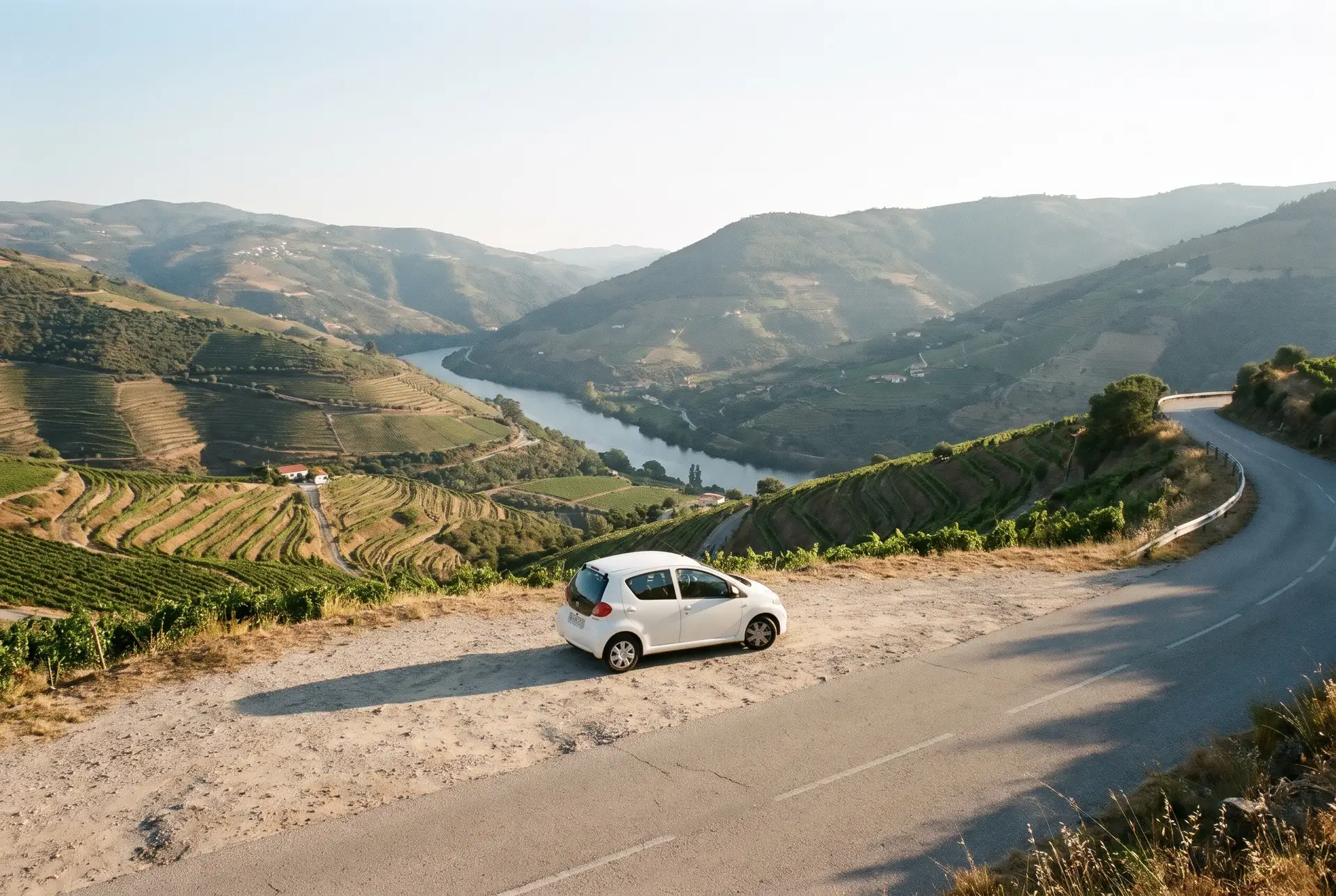
 Image generated by AI
Portugal
Car hire in Portugal
From €23 a day on a 7-day rental and from €31 for a single day, as of November 5, 2026, for cars with a deposit of up to €300: five airports, town offices and delivery to your hotel, and some cars with no credit card needed.
from €23 per day on a 7-day rental
from €31 for a single day, as of November 5, 2026
Search and book
A live catalogue with prices and availability for your dates. You pay part of the total when you book and the rest on collection. Your rental contract is with the rental company.
Ad · companies may pay Roamo for referrals
Do you need a car in Portugal?
Not always. If you are flying to Lisbon or Porto for a few days, a car will just sit in a car park: the centre is easier on foot and by metro, the metro runs from the airport too, and parking in the old quarters is hard work.
A car pays for itself beyond those cities: Sintra and Cabo da Roca, the Douro Valley, the Algarve. On Madeira and São Miguel it makes the viewpoints and lakes much easier to reach. A good pattern is a few days in the city without one, then a car for the touring days, delivered to your hotel.
How much does car hire cost in Portugal?
Car hire in Portugal starts from €23 a day on a 7-day rental and from €31 for a single day, as of November 5, 2026, for cars with a deposit of up to €300. The price moves with the season and differs between the mainland and the islands, so look at the price for your own dates. Summer costs noticeably more than winter, and January and February are the cheapest months.
Each city has its own starting price: see the pages for Lisbon, Porto, Faro, Funchal and Ponta Delgada. The company works out the exact amount for your dates.
On Madeira a levy comes on top: €2 a day as of 1 November 2026, up to €20 per rental. It is not included in the booking price, and you pay it when you collect the car. Demand is highest from June to August and peaks in August, so book early for those months. You pay 15–20% when you book and the rest to the company on collection.
Where to collect a car: airports and cities
There are five collection points with airports: Lisbon (LIS), Porto (OPO), Faro (FAO), Funchal on Madeira (FNC) and Ponta Delgada on São Miguel (PDL). The company’s agent hands over the car, and the contact details are on your voucher. Collection takes 15–20 minutes: the contract, the balance and deposit, then an inspection and photos. Return takes about 10 minutes.
Beyond the airports there are town offices and delivery to your address or hotel, plus the port in Ponta Delgada; which points are available depends on the car. You can return the car in another city: collect in Porto and drop off in Lisbon, for example. The minimum rental is 24 hours, and a part day counts as a full one. Queues at passport control in Lisbon and at other airports can be long, so allow time before you collect the car.
What you need to hire a car: documents, age, deposit, insurance
You need a passport, a driving licence and a bank card, all originals. The licence must show your details in Latin script and be valid until the end of the rental; copies and digital licences are not accepted. A UK licence is valid in Portugal for up to 185 days after you enter, with no International Driving Permit, and an EU licence needs no permit either. Age is usually from 21–24 with at least a year’s driving, and the widest choice is from 25 with three years’ experience; the exact terms are on the car’s listing.
The deposit is usually from €150–300, and up to €800 on São Miguel; the amount is on the car’s listing. It may be held for up to a month, as bills for tolls and fines come in during that time. Some cars require a physical credit card with raised numbers in the main driver’s name, so a card on your phone will not do. Others can be hired without a credit card, which you can see when you book.
Basic cover is included in the price and many cars come with extended cover; standard cover excludes wheels, the underside, the windscreen and the interior. What the letters in the contract mean is explained in Insurance and deposit: what the letters mean — written for Montenegro, but the system is the same.
Before you go: entry, phones and money for UK travellers
Portugal is in the EU and Schengen, and Madeira and the Azores are part of the same system. UK passport holders can stay up to 90 days in any 180 without a visa. The EU’s Entry/Exit System (EES) has been fully running since 10 April 2026: on your first entry your photo and four fingerprints are taken instead of a passport stamp, and fingerprints are not taken from children under 12. The first crossing takes longer, and Portuguese airports have had long queues at passport control. ETIAS has not launched and is not needed yet, so keep an eye on the news. Irish and other EU citizens can travel on a passport or national ID card.
Roaming on a UK SIM depends on your network: some charge a daily fee, others include the EU in your plan with limits, so check before you fly. An Irish SIM roams at home prices under EU rules. Your phone needs to work throughout the rental, as that is how the company reaches you.
The currency is the euro, and UK and Irish bank cards work. Keep some coins for parking machines; in small towns some petrol stations take cash only. Mainland Portugal and Madeira are on the same time as the UK and Ireland, and the Azores are an hour behind. Portuguese is the language, though people working in tourism generally speak English.
Toll roads, gantries and transponders
Portugal has three kinds of motorway. The first is free: the A22 in the Algarve, the A23, A24, A4 Transmontana and A13, and since 2026 the whole of the A25. The A22 has been free since 2025, so you neither pay for it nor need a transponder for it. The gantries over these roads are still there, but cars are not charged.
The second has toll booths: as of 1 November 2026 the A1 Lisbon–Porto costs €25.05 and the A2 Lisbon–Algarve €23.80, and the A3, A5 and A6 work the same way. You can pay on exit in cash or by card; lanes with a green V are for transponders only, so stay out of them if you do not have one. The Tagus bridges charge only on the way into Lisbon: €2.25 on the 25 de Abril Bridge and €3.40 on the Vasco da Gama. Tariffs change every January.
The third has no toll booths, only gantries over the road: these are around Porto, and on them you need a Via Verde transponder. When you collect the car, ask whether it has one and what it costs: some companies charge for the device and may freeze a deposit for tolls. The tolls themselves reach you on a bill later, which is why the deposit may be held for up to a month. There are no toll roads on Madeira.
The islands and Spain: where you can take a hire car
Madeira and the Azores lie out in the Atlantic, and no car goes there from the mainland: there are no ferries and the contract does not allow it. Fly out and hire a car on the island. Another island means another car too. If your plans include both the mainland and an island, budget for two rentals.
You can drive a hire car to Spain, but you must choose the option when you book and tell the company in advance. Take a car with permission to cross the border: without it you are breaking the contract and your insurance is in doubt. The border is 65 km from Faro, and from Porto the obvious run is to Vigo. If most of your trip will be there, look at car hire in Spain.
Driving in Portugal: rules, fines, parking and petrol
Portugal drives on the right, and you overtake on the left. In town the limit is 50 km/h, or 30 near schools and in residential areas; outside towns it is 90, on expressways 100 and on motorways 120. With less than a year’s driving experience the limit is 90 at most. The usual alcohol limit is 0.5 g/l and 0.2 for new drivers, so it is better not to drink at all. On a roundabout, the cars already on it have priority; at unmarked junctions, give way to traffic from the right. Dipped headlights are best kept on in the daytime too. Children under 12 and under 135 cm travel in a child seat. Check at collection that the high-visibility vest and warning triangle are in the car, and keep your passport and rental contract with you.
Fines are steep: as of 1 November 2026, from €250 for using a phone at the wheel, from €60 for speeding and from €120 for no seatbelt. A new road code is being prepared, so these amounts may change. Braking for the camera does not help, as some roads measure your average speed. Camera fines go to the rental company and are taken from your deposit along with an administration fee.
In Lisbon, the street parking rate depends on the colour zone, and the machine or app shows the amount; you can stay two hours at most in the centre, and Sundays are free. Elsewhere, check the markings against the sign: usually blue means paid, white free, yellow no parking and green residents only. Machines often take coins only and give no change. Park in the direction of the traffic, not facing it.
As of 31 October 2026 the mainland average is €2.03 a litre for petrol and €2.19 for diesel, so diesel is the dearer of the two; a 45-litre tank of petrol comes to about €91. If you are crossing the border, filling up in Spain is noticeably cheaper. Madeira and the Azores have their own prices, set by the regional governments. At the pump, gasolina 95 or 98 is petrol and gasóleo, despite the name, is diesel. Fuel costs more on the motorways.
Where to go with a hire car
From Lisbon: Sintra (28 km), Cabo da Roca (41 km), Óbidos (85 km), Évora (134 km). From Porto: Guimarães (54 km), Braga (56 km), Aveiro (75 km), the Douro Valley (94 km to Peso da Régua) and Peneda-Gerês National Park (about 95 km). Lisbon to Porto is 314 km, about 3.5 hours; Lisbon to Faro is 278 km, about 3 hours; Porto to Faro is 553 km, about 6 hours.
In the Algarve, from Faro: Tavira (38 km), Albufeira (46 km), Lagos (86 km), Sagres and Cape St Vincent (about 1.5 hours). On Madeira, from Funchal: Cabo Girão (13 km), Pico do Arieiro (20 km), Porto Moniz (50 km). On São Miguel, from Ponta Delgada: Sete Cidades (26 km) and Furnas (43 km). Times and distances are without traffic, so allow a margin.
What can go wrong
Hire cars may only be driven on tarmac. Some Algarve beaches are reached by dirt tracks, where the insurance does not apply, so check the route in advance. After a breakdown or accident, tell the company straight away and get a police report, or the insurance is void. If someone not named on the contract is driving, the insurance is invalid. Your phone, with its country code, must be reachable throughout the rental.
On the mainland you do not need winter tyres, and snow falls only in the Serra da Estrela. On Madeira the mountain roads are closed in bad weather, so check the forecast before heading for Pico do Arieiro. Flights to Madeira are cancelled because of wind, so leave some margin and do not book anything for your arrival day that you cannot move. In the Azores, pack a rain jacket whatever the month.
Fines, parking and tolls are the renter’s to pay: anything unpaid comes out of the deposit along with an administration fee. To compare how it works elsewhere, see car hire in Greece and in Italy.
Good to know
See the price before you pay
The catalogue shows the total for your dates before you pay, along with the deposit and rental terms.
Terms before you pay
The deposit, mileage and whether you need a credit card are visible before you pay. Some cars can be hired without a credit card.
Five airports
Lisbon, Porto, Faro, Funchal and Ponta Delgada — collection at the airport. In town: offices and delivery to your hotel.
How it works
Pick dates and a class
See what is free on your dates and compare price, deposit and insurance.
Book with the rental company
15–20% online, the rest on collection. Going to Spain? Choose the cross-border option when you book.
Collect the car
At the airport, an office or your address — the company’s contact details are on your voucher. Ask about a transponder and check the vest and warning triangle are there.
Conditions
- Licence
- The original national licence with your details in Latin script, valid until the end of the rental; copies and digital licences are not accepted. A UK or EU licence needs no International Driving Permit; a permit is worth having if your licence is not in Latin script or is valid only at home. You also need a passport and a bank card.
- Age and experience
- Usually from 21–24 with at least a year’s driving; the widest choice is from 25 with three years’ experience. The exact terms are on the car’s listing.
- Deposit
- Almost always required: usually from €150–300, and up to €800 on São Miguel; the amount is on the car’s listing. It may be held for up to a month, as bills for tolls and fines come in during that time.
- Insurance
- Basic cover is included, and many cars already come with extended cover. Standard cover excludes wheels, the underside, the windscreen and the interior. After an accident, tell the company straight away and get a police report.
- Borders and ferries
- Spain only with the cross-border option, chosen when you book. No car goes from the mainland to Madeira or the Azores: there are no ferries and the contract does not allow it. On an island you hire a separate car.
- Fuel
- Return the car with the same fuel level as at collection. Any shortfall is charged at the company’s rate; extra fuel is not refunded.
- Season
- Demand for hire cars is highest from June to August and peaks in August, so book early for those months. January and February are the cheapest. Madeira is warm all year, though winters are rainy in the north and the mountains; in the Azores it can rain in any month.
By city
Common questions
How much does car hire cost in Portugal?
From €23 a day on a 7-day rental and from €31 for a single day, as of November 5, 2026. These are prices for cars with a deposit of up to €300. Summer costs noticeably more than winter, and January and February are the cheapest months. The company works out the exact amount for your dates.
Can I hire a car without a deposit or a credit card?
Almost every car carries a deposit, though Madeira has a separate filter for cars without one. Some cars can be hired without a credit card, which you can see when you book, but the company may then ask for a bigger deposit or full insurance.
Do I need an International Driving Permit in Portugal?
Not with a UK licence: it is valid for up to 185 days after you enter. An EU licence needs no permit either. A permit is worth having if your licence is not in Latin script or is valid only at home. Originals only.
What kind of bank card do I need?
For some cars, a physical credit card with raised numbers in the main driver’s name. A debit card is sometimes accepted, on the same terms. Some cars can be hired without a credit card, and how you can pay the balance is shown on the listing.
Which roads are tolled, and do I need a transponder?
The A22 in the Algarve has been free since 2025. The A1 Lisbon–Porto and A2 Lisbon–Algarve are tolled, and you can pay on exit in cash or by card. Around Porto some stretches have no toll booths, only gantries over the road, and for those you need a transponder. When you collect the car, ask whether it has one and what it costs.
Can I drive a hire car to Spain?
Yes, but you must choose the option when you book and tell the company in advance. Take a car with permission to cross the border: without it you are breaking the contract and your insurance is in doubt.
Can I take the car to Madeira or the Azores?
No. There are no ferries from the mainland and the contract does not allow it. Fly out and hire a car on the island. Another island means another car too.
What are the speed limits in Portugal?
50 km/h in town and 30 near schools and in residential areas; 90 outside towns, 100 on expressways and 120 on motorways. With less than a year’s driving experience, 90 at most. Portugal drives on the right.
How do I cancel a booking?
Free up to 7 days before the rental starts, or 30 days for convertibles and luxury cars; with the free cancellation option, up to 24 hours before. A 6% payment fee is kept, and the prepayment is refunded within 14 days.