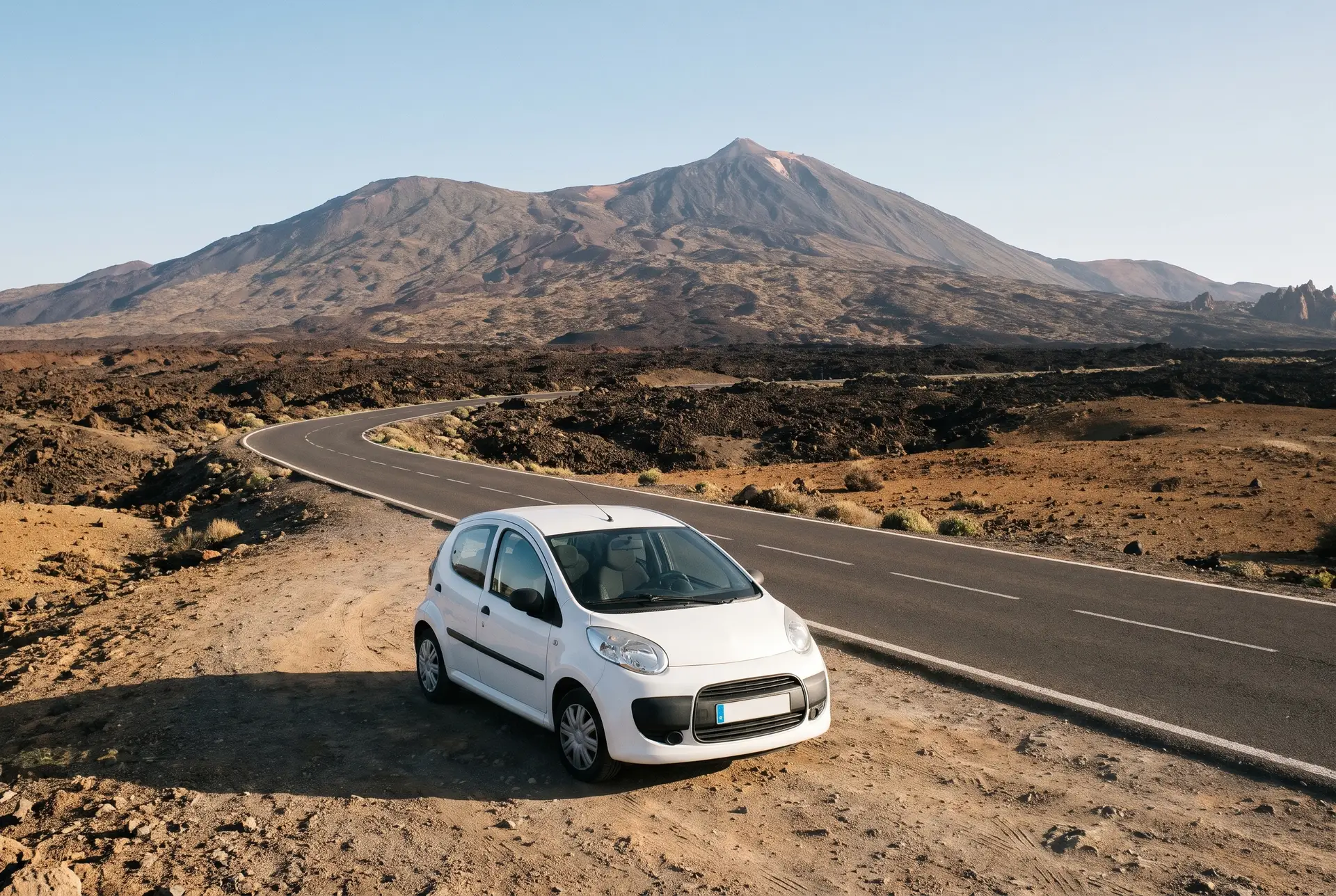
 Image generated by AI
Spain
Car hire in Spain
From €14 a day on a 7-day rental and from €15 for a single day, as of November 5, 2026, for cars with a deposit of up to €450: eight airports, railway stations, town offices and delivery to your hotel. The terms are shown before you pay.
from €14 per day on a 7-day rental
from €15 for a single day, as of November 5, 2026
Search and book
A live catalogue with prices and availability for your dates. You pay part of the total when you book and the rest on collection. Your rental contract is with the rental company.
Ad · companies may pay Roamo for referrals
Do you need a car in Spain?
Not always. On a short break in Madrid or Barcelona a car will just sit there: the centres are easier on foot and by metro, and what you pay to park depends on the car’s environmental label. From Málaga airport a train runs along the coast, and in Gran Canaria buses link the airport with Las Palmas and the southern resorts. For a holiday on one beach that is enough.
A car pays for itself once you leave town: Toledo and Segovia from Madrid, the Costa Brava from Barcelona, Ronda and Granada from Málaga, the mountains of Mallorca, Teide and Roque Nublo in the Canaries. A good pattern is a few days in the city without one, then a rental for the touring days.
How much does car hire cost in Spain?
Nationwide, a hire car costs from €14 a day on a 7-day rental and from €15 for a single day, as of November 5, 2026. These are prices for cars with a deposit of up to €450, and they move with your dates and differ from city to city. On the mainland and in Mallorca, January is the cheapest month, whether you collect in Barcelona, Madrid, Málaga, Alicante or Mallorca.
The Canaries are the other way round. In Gran Canaria, December and February are the dearest months and summer and September the cheapest. In Tenerife, winter is high season and September and October cost least. Book early for the winter holidays.
Across Spain demand peaks in April and May and stays high through the summer, so book ahead for those months. The company works out the exact amount. You pay 15–20% by card and the rest on collection. The minimum rental is 24 hours, and a part day counts as a full one.
Where to collect a car: airports and cities
Eight airports: Madrid (MAD), Barcelona (BCN), Málaga (AGP), Alicante (ALC), Palma in Mallorca (PMI), Tenerife South (TFS) and North (TFN) in Tenerife, and Gran Canaria (LPA). Cars are handed over at the airport, at an office or at your hotel, and the place is on the car’s listing. Madrid also has collection at Chamartín and Atocha stations, and Barcelona at Sants.
You can return the car in another city: collect in Barcelona and drop off in Madrid, for example. Early collection and late-night return may cost extra, and the charge is shown before you pay the prepayment. On the day you land, the choice is noticeably smaller.
What you need to hire a car: documents, age, deposit, insurance
You need a passport, a driving licence and a bank card, all originals. The licence must show your details in Latin script and be valid until the end of the rental. A UK photocard licence is valid in Spain; update an old paper licence before you travel, and note that a provisional licence is not valid. An EU licence needs no International Driving Permit. With another non-EU licence, get one before you travel, as Spain’s traffic authority advises. Age is usually from 22–25 with 1–2 years’ driving, and the widest choice starts at 26; the exact terms are on the car’s listing.
The deposit depends on the car and is usually a few hundred euros; some cars have none. Some cars can be hired without a credit card, which you can see when booking, though the company may still ask for card details as a guarantee. Where a card is needed, it must be a physical one with raised numbers in the main driver’s name.
Basic cover is always included; extended cover costs extra on some cars and is often part of the price in the Canaries. Standard cover excludes wheels, the underside, the windscreen and the interior. What the letters in the contract mean is explained in Insurance and deposit: what the letters mean, which was written for Montenegro, but the system is the same. Some cars have a mileage limit, shown on the listing and counted over the whole rental.
Cancellation is free up to 7 days before the rental starts, 30 days for convertibles and luxury cars, or 24 hours with the free cancellation option. A 6% payment fee is kept and the prepayment is refunded within 14 days; if you do not turn up, it is not refunded.
Before you go: entry, phones and money for UK travellers
Spain is in the EU and Schengen, and the Canaries and Balearics are part of both. UK passport holders can stay up to 90 days in any 180 without a visa. Your passport must have been issued less than 10 years ago and be valid for 3 months after you leave, and at the border you may be asked for a return ticket, travel insurance, funds and a hotel booking. The EES system takes your fingerprints on arrival; it is free, but queues are longer. ETIAS is not running yet and no date has been announced, so check before you travel. Irish citizens travel as EU citizens and do not need any of this.
UK networks have not had to offer free EU roaming since 2021. Most charge a daily fee, and O2 has no daily fee but sets a limit, so check your plan. Irish and other EU SIM cards roam at home prices. Your phone must stay reachable throughout the rental, as that is how the company contacts you.
The currency is the euro. Keep some cash for small petrol stations and older parking machines, and declare €10,000 or more on entry. Carry your licence and passport when you drive. The mainland and the Balearics are one hour ahead of the UK and Ireland, while the Canaries keep the same time. Spanish is the main language, with road signs also in Catalan or Valencian in Catalonia, the Balearics and around Valencia, so Alicante may appear as Alacant. English is spoken in tourist areas. The emergency number is 112.
Roads, rules and fines
Spain has no vignettes, and most motorways are free, including Madrid–Barcelona and the coast from France to Alicante. Tolls are mostly around Madrid and on the Costa del Sol, where Málaga to Guadiaro costs €12, or €19.55 from June to September. There is nearly always a free road alongside, and Mallorca and the Canaries have no tolls at all. You pay at booths in cash or by card; the Via-T lanes are for transponders only. Prices as of 1 November 2026.
Spain drives on the right, and if you are used to the left, an automatic takes one job off your hands. Most town streets are 30 km/h, with 50 only where there are two or more lanes each way and 20 where road and pavement are level. Outside towns it is 90, on motorways 120. Roundabouts run anticlockwise: give way to cars already on them and indicate right before your exit. The usual alcohol limit is 0.5 g/l, and 0.3 for drivers in their first two years; better not to drink at all. Children up to 135 cm tall ride in a child seat in the back. Leave at least 1.5 m when overtaking a cyclist.
Fines are high. A phone in your hand, no seatbelt or a red light each cost €200, and speeding costs €100–600. Headphones are banned, even in one ear. Paying within 20 days cuts the fine by half. If you do not live in Spain, an officer can require payment on the spot, by card or in cash, and the half-price rate still applies; if you do not pay, the car can be immobilised. It is illegal to carry a radar detector. Even in a hire car, the driver answers for any offence.
The V-16 beacon that replaced the warning triangle
Since 2026 Spain has used the V-16 beacon instead of a warning triangle: a yellow light you put on the roof without getting out of the car. It sends its own signal to the DGT, the traffic authority. The rule covers cars registered in Spain, so hire cars are included.
When you collect the car, check that the beacon is there and ask where it is kept. Find the high-visibility vest while you are at it: you need it if you step out onto the road or hard shoulder outside a town. All this is easiest to check at the desk, before you drive off.
Low emission zones and environmental labels
Madrid and Barcelona have low emission zones (ZBE) that shut out older cars with no environmental label. The DGT labels are 0 (electric), ECO (hybrid, gas), C (petrol from 2006, diesel from 2015) and B. Cameras check the plate against a database, so they do not need to see a sticker, and only foreign plates have to be registered. A hire car on Spanish plates is usually fine, but ask at the desk which label it has.
With a C label you can enter central Madrid only to go straight to a paid car park, and it is better not to drive into the old towns of Palma and Alicante at all. In Barcelona the zone operates on weekdays from 7:00 to 20:00, and a car with a label is not restricted. In Málaga a court struck down the rules in October 2026 and the city is writing new ones. The general fine is €200, or €100 if paid within 20 days. Rules change and the zones are being fought over in the courts, so check the city before you travel.
Parking and petrol
Blue lines are paid parking, green are for residents, white are free and yellow mean no parking. The rate depends on the environmental label: as of 1 November 2026, an hour in a blue bay in Barcelona costs €3.00–3.25 for a petrol car with a C label. In the old centres, use an underground car park. Paid hours vary by city, so read the machine. Fines, parking and tolls are the renter’s to pay.
As of 1 November 2026, petrol averages €1.72 a litre and diesel €1.90. The Canaries are cheaper (petrol €1.51–1.56) and Mallorca dearer (€1.81). A 45-litre tank comes to about €78. Fuel tax has been cut temporarily, so prices may rise. Most stations are self-service: green pumps are 95 and 98 petrol, black are diesel. Fill up before heading into the mountains.
Where to go with a hire car
From Madrid: Toledo (about 1 hour), Segovia (about 1 hr 20 min), El Escorial (about 50 minutes). From Barcelona: Sitges (about 40 minutes), Girona (about 1 hr 20 min), the Costa Brava. From Málaga: Nerja and Marbella (about 50 minutes), Ronda (about 1 hr 45 min), Granada (under 2 hours). From Alicante: Altea, Calpe and Guadalest (45–60 minutes). All times are without traffic.
Between cities, Madrid–Barcelona is about 620 km and 6 hr 50 min, toll-free; Madrid–Málaga about 540 km and 6 hours; Madrid–Alicante about 420 km and 4 hr 40 min; Barcelona–Valencia about 350 km and 4 hours. In Mallorca people head for the Tramuntana mountains, in Tenerife for Teide National Park, and in Gran Canaria for Roque Nublo and the Maspalomas dunes.
Formentor, Masca, Teide: where access is restricted
In Mallorca, you cannot drive your own car to the Formentor lighthouse in summer from 10 in the morning until 10 at night; you have to take the bus. In 2026 the ban ran from 15 May to 18 October, so check the dates before you go.
In Tenerife, a single narrow road, the TF-436, leads to Masca. During a fire alert cars are kept out and a bus runs instead, so check before you set off. You can drive into Teide National Park without booking, but in winter the roads close when it snows, so check that morning. Access rules change; see the Cabildo’s website.
In the Canary Islands’ mountains, watch the signs: some roads are closed to traffic in rain, and heavy rain can bring rockfalls and closures. A hire car may be driven only on public tarmac roads. On dirt tracks the insurance does not apply and repairs are at your own expense.
What can go wrong
Crossing a border without agreement. Portugal, France, Andorra and Gibraltar are usually possible, but not in every car and only by arrangement: tell the company before you book and check that the trip is written into the contract. It is usually a paid extra. Some motorways in Portugal have no toll booths, so ask the company how a car from Spain pays. Andorra is outside Schengen, so on a single-entry Schengen visa, leaving for it may cost you re-entry to Spain; check before you plan that route.
Ferries need the company’s agreement too, arranged before you book, as not every car is allowed. After an accident or breakdown, tell the company straight away and get a police report, or the insurance is void. Your phone, with its country code, must be reachable throughout the rental.
In winter, check the forecast and road closures before heading into the mountains, as hire cars normally run on ordinary tyres. That goes for the Sierra de Guadarrama near Madrid as well as the climbs to Teide in the Canaries.
Good to know
See the price before you pay
The catalogue shows the total for your dates before you pay, along with the deposit and rental terms.
The terms before you pay
The deposit depends on the car and is usually a few hundred euros; some cars have none. The amount and the insurance are on the listing.
Eight airports
Madrid, Barcelona, Málaga, Alicante, Palma, both Tenerife airports and Gran Canaria. In town: offices and delivery to your hotel.
How it works
Pick dates and a class
See what is free on your dates and compare price, deposit and insurance.
Book with the rental company
15–20% by card, the rest on collection. Planning a trip abroad or a ferry? Agree it with the company before you book.
Collect the car
At the airport, an office or your hotel. Check the V-16 beacon is there and ask which environmental label the car has.
Conditions
- Licence
- The original licence with details in Latin script, valid until the end of the rental; copies and digital licences are not accepted. A UK photocard or EU licence is valid in Spain. Update an old paper UK licence first; a provisional one is not valid. With another non-EU licence, get an International Driving Permit before you travel. You also need a passport and a bank card.
- Age and experience
- Usually from 22–25 with 1–2 years’ driving; the widest choice starts at 26. The exact terms are on the car’s listing.
- Deposit
- Depends on the car and is usually a few hundred euros; some cars have none. Some cars can be hired without a credit card, which you can see when booking, though the company may still ask for card details as a guarantee. Cars with no deposit are rare in Gran Canaria.
- Insurance
- Basic cover is always included; extended cover costs extra on some cars and is often included in the price in the Canaries. Standard cover excludes wheels, the underside, the windscreen and the interior. After an accident, tell the company straight away and get a police report, or the insurance is void.
- Borders and ferries
- Portugal, France, Andorra and Gibraltar are usually possible, but not in every car and only if agreed before you book; it is usually a paid extra. Ferries only with the company’s agreement, and not every car is allowed. A car hired on an island does not go abroad. Andorra is outside Schengen, which matters on a single-entry Schengen visa.
- Fuel
- Return the car with the same fuel level as at collection. Any shortfall is charged at the company’s rate; extra fuel is not refunded.
- Season
- Demand peaks in April and May and stays high through the summer, so book ahead for both seasons. On the mainland and in Mallorca, January is the cheapest month. The Canaries are the other way round: summer and early autumn cost least, and for the winter holidays you should book early, especially an automatic, as most cars there are manual.
By city
Common questions
How much does car hire cost in Spain?
From €14 a day on a 7-day rental and from €15 for a single day, as of November 5, 2026; these are prices for cars with a deposit of up to €450. On the mainland and in Mallorca, winter is the cheapest time, January especially; in the Canaries, summer and early autumn cost least. The company works out the exact amount for your dates.
Can I hire a car without a deposit?
Yes, some cars have none. Otherwise it depends on the car and is usually a few hundred euros, shown on the listing before you pay. In Gran Canaria cars with no deposit are rare. Some cars are also handed over without a credit card, though the company may still ask for card details as a guarantee.
Do I need an International Driving Permit in Spain?
Not with a UK photocard licence or an EU licence, Irish ones included. With another non-EU licence, get one before you travel: Spain’s traffic authority, the DGT, advises it, and the rental terms strongly recommend it. Originals only, with details in Latin script; copies and digital licences are not accepted.
What kind of card do I need?
Where a credit card is required, it must be a physical card with raised numbers in the main driver’s name. A debit card is sometimes accepted, and the voucher will say so. Some cars can be hired without a credit card, which you can see when booking.
Can I drive a hire car to Portugal or France?
Portugal, France, Andorra and Gibraltar are usually possible, but not in every car and only by agreement. Tell the company before you book and check that the trip is written into the contract. It is usually a paid extra. Andorra is outside Schengen, so on a single-entry Schengen visa, the trip may cost you re-entry to Spain.
Can I take the car on a ferry?
Only with the company’s agreement, arranged before you book, as not every car is allowed. It is often simpler to hire a separate car on each island: Gran Canaria to Tenerife takes 80 minutes, and Tenerife to La Gomera 50 minutes.
What is a V-16 beacon?
Since 2026 Spain has used the V-16 beacon instead of a warning triangle. You put it on the roof without getting out of the car. When you collect the car, check that it is there and ask where it is kept.
What is a DGT label, and does a hire car need one?
It is the environmental label issued by Spain’s traffic authority: 0, ECO, C or B. Low emission zone cameras check the number plate against a database, so they do not need to see a sticker, and only foreign plates have to be registered. Hire cars on Spanish plates are usually new, but ask at the desk which label yours has.
What are the speed limits in Spain?
Most town streets are 30 km/h, with 50 only where there are two or more lanes each way and 20 where road and pavement are level. Outside towns it is 90 and on motorways 120. Spain drives on the right.
How do I cancel a booking?
Free up to 7 days before the rental starts, or 30 days for convertibles and luxury cars; with the free cancellation option, up to 24 hours before. A 6% payment fee is kept, and the prepayment is refunded within 14 days. If you do not turn up, it is not refunded.