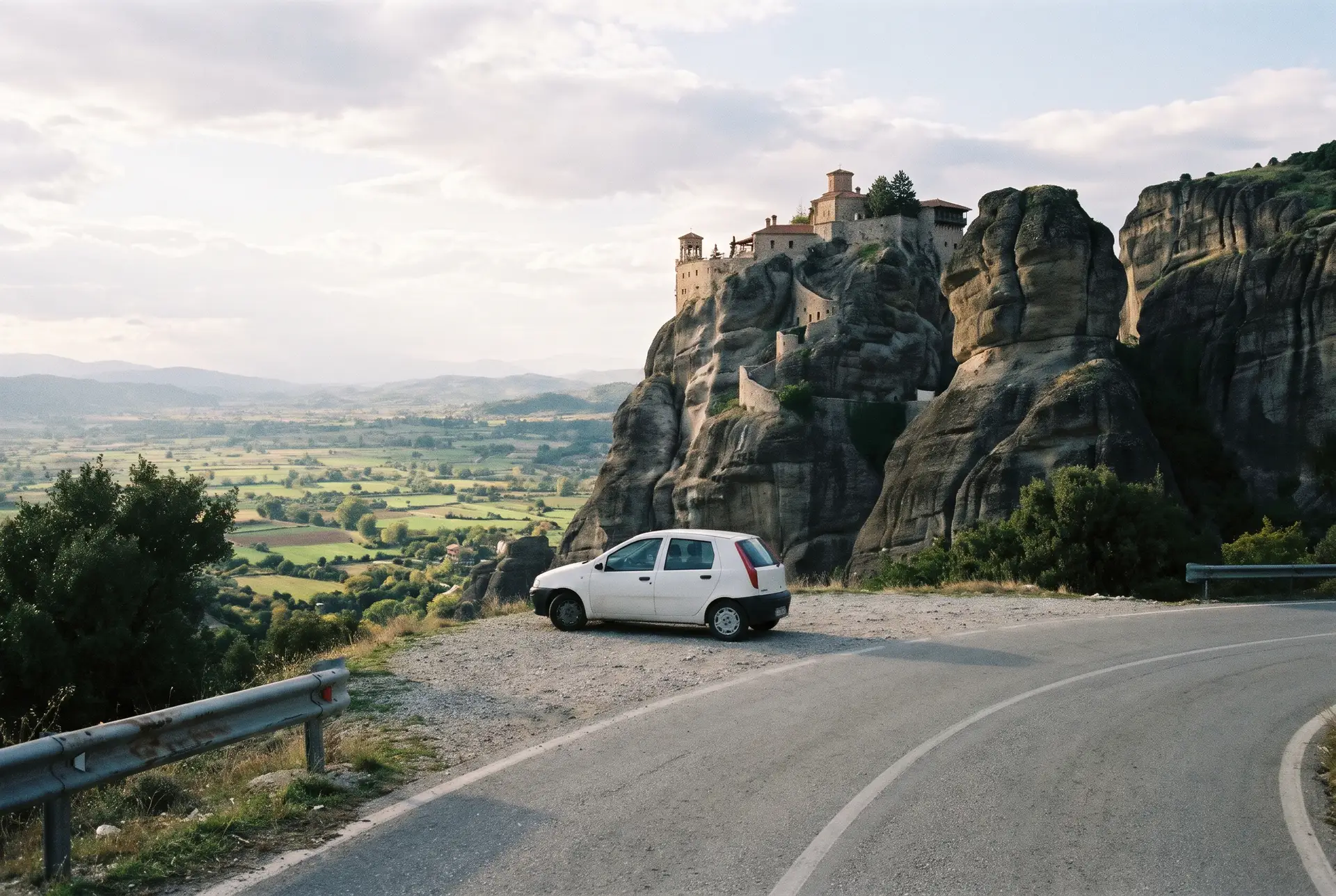
 Image generated by AI
Greece
Car hire in Greece
From €11 a day on a 7-day rental and from €22 for a single day, as of November 1, 2026: six airports, delivery to your address or the port, and some cars with no deposit.
from €11 per day on a 7-day rental
from €22 for a single day, as of November 1, 2026
Search and book
A live catalogue with prices and availability for your dates. You pay part of the total when you book and the rest on collection. Your rental contract is with the rental company.
Ad · companies may pay Roamo for referrals
Do you need a car in Greece?
Not always. If you are spending a week in Athens for the Acropolis and the museums, a car will sit in a paid car park: the centre is easier on foot and by metro. On a small island with your hotel on the beach, it is often surplus too.
A car pays for itself on the mainland beyond the capital — Sounion, Delphi, Meteora, Halkidiki, the Peloponnese — and on the big islands. On Crete, Rhodes and Corfu the buses mostly link the towns and the coast, while the best beaches, monasteries and mountain villages are where they do not go.
How much does car hire cost in Greece?
Of the six cities in this guide, Thessaloniki is the cheapest on a 7-day rental, from €11 a day, and Heraklion for a single day, from €22, as of November 1, 2026. The islands are usually 15–25% dearer. Across the country January to March is cheapest, prices rise by May, and August costs roughly double the winter rate.
The islands rise at different rates. Corfu has the sharpest gap: August costs around four times the winter rate. On Rhodes and in Chania the peak is September, not August. The company works out the exact amount for your dates.
Demand is high from June to September and peaks in September. Most Greek hire cars are manual, so book an automatic for the summer as early as you can. You pay 15–20% online and the rest to the company on collection.
Where to collect a car: airports and cities
Six collection points with airports: Athens (ATH), Thessaloniki (SKG), Heraklion (HER) and Chania (CHQ) on Crete, and the islands of Rhodes (RHO) and Corfu (CFU). At the airport the agent meets you in arrivals or in the terminal car park and gets in touch a day or two beforehand; Corfu has a desk in arrivals.
Beyond the airports there are town offices and delivery to your address, the port in Heraklion and the railway station in Athens. You can return the car in another city: collect in Chania and drop off in Heraklion, for example. The minimum rental is 24 hours, and a part day counts as a full one. Most cars have unlimited mileage; where there is a cap, such as 200 km a day, it is on the listing.
What you need to hire a car: documents, age, deposit, insurance
A passport, your original driving licence valid until the end of the rental, and a bank card. A UK photocard licence is valid in Greece without an IDP, but the rental terms recommend one and some companies will not hand over a car without it; an old paper licence needs an IDP. Age is usually from 21–23 with a year’s driving; the exact terms are on the car’s listing.
Most cars carry a deposit, but you can find some without, and some are handed over without a credit card. Where a card is needed, it must be a physical card with raised numbers in the main driver’s name. Basic cover is included and many cars come with extended cover; standard cover excludes tyres and wheels, the underside, the windscreen and the interior. If cover is not on the listing, you cannot add it later. What the letters in the contract mean is explained in Insurance and deposit: what the letters mean — written for Montenegro, but the system is the same.
A Greek hire car cannot leave Greece — not to Albania, North Macedonia, Bulgaria or Turkey. Ferries only with the company’s agreement before you book. Tarmac only: on dirt tracks the insurance does not apply.
Before you go: entry, phones and money for UK travellers
Greece is in the EU and Schengen. UK passport holders can stay up to 90 days in any 180 without a visa; since April 2026 the EES system takes fingerprints and a photo at the border instead of a passport stamp. From late 2026 you may also need an ETIAS travel authorisation — the EU has not set a firm date, so check before you travel.
Since Brexit, roaming at home prices is not guaranteed for UK SIM cards: it depends on your network, so check your plan. Your phone needs to work throughout the rental, as that is how the company reaches you. The currency is the euro; keep €20–50 in cash for village petrol stations and tavernas, where cards are not always accepted.
Roads, tolls, parking and petrol
Tolls are charged on mainland motorways only, and there are no vignettes. Entering the Attiki Odos — the Athens ring road and the road to the airport — costs €2.55; Athens to Thessaloniki comes to roughly €30–40 for the whole journey; Elefsina–Patras on the Olympia Odos is €13.80, and the Rio–Antirrio bridge €15.90. Since 2026 the Egnatia Odos charges €0.04 per km plus VAT. You pay before entering each section, in cash or by card. Crete, Rhodes and Corfu have no toll roads. Prices checked in October 2026.
A new road code took effect on 13 September 2025: a phone at the wheel or no seatbelt means €350 and a month’s ban, a red light €700. Since 2026 most town streets are 30 km/h and the big ones 50; outside towns it is 90, on expressways 110 and on motorways 130. Traffic drives on the right. The usual alcohol limit is 0.5 g/l, 0.2 for drivers with under two years’ experience — better not to drink at all. Wear closed shoes, not flip-flops.
Parking: blue lines are paid, white free, yellow no parking. Athens is the other way round: white is paid, for up to three hours, and blue is for residents only. In autumn 2026 petrol costs about €2.20 a litre and diesel about €2.12, so a 45-litre tank is about €100. Fuel costs more on the islands, village stations close by 20:00 and cards are not taken everywhere in the countryside. An attendant usually fills up for you: just say “95” or “diesel”.
Where to go with a hire car
From Athens: Cape Sounion (70 km), Delphi (about 2.5 hours), Nafplio (1.5–2 hours). From Thessaloniki: Sithonia in Halkidiki (about 1.5 hours), Mount Olympus via Litochoro and Meteora (2.5–3 hours). Athens to Thessaloniki is about 500 km, 5–6 hours.
On Crete, from Heraklion: Knossos (5 km), Malia (35 km), Gortyna (45 km), Matala (65 km); from Chania: Elafonisi (1–1.5 hours) and Falasarna (about 50 minutes). On Rhodes, Lindos and Prasonisi; on Corfu, Paleokastritsa, Sidari and Mount Pantokrator. The islands are easier to explore with a car hired locally than with one brought over by ferry.
What can go wrong
A ferry without the company’s agreement breaks the contract, and some roads — like the track to Balos lagoon on Crete — are off-limits to hire cars altogether. After a breakdown or accident, tell the company straight away and get a police report, or the insurance is void. Your phone, with its country code, must be reachable throughout the rental.
In winter there can be snow in the mountains — on Olympus, around Meteora, on Crete’s plateaux — and chains are required when it falls, so ask the company for them when you book. On the smaller islands much is shut from late October to early May and there are fewer ferries; Crete, Rhodes and Corfu stay open all year. Parking fines and tolls are the renter’s to pay — an unpaid fine is charged by the company later.
Car or bus?
In Athens, use the metro or bus from the airport and walk round the centre; you need a car only for trips out of town. From Chania airport the KTEL bus runs into town, and on Corfu town buses 5 and 6 do the same. On the islands buses link the towns and coastal resorts but not the mountains or the remoter beaches.
A good pattern is a few days in the city without a car, then a rental for the touring days, delivered to your hotel. To compare how it works elsewhere in the region, see car hire in Albania and in Montenegro — but remember that a Greek hire car stays in Greece.
Good to know
See the price before you pay
The catalogue shows the total for your dates before you pay, along with the deposit and rental terms.
No-deposit options
Most cars carry a deposit, but the filter finds ones without it and without a credit card.
Six airports
Athens, Thessaloniki, Heraklion, Chania, Rhodes and Corfu — collection at the terminal. In town: offices, the port and delivery to your address.
How it works
Pick dates and a class
See what is free on your dates and compare price, deposit and insurance.
Book with the rental company
15–20% online, the rest on collection. Planning a ferry? Agree it with the company before you book.
Collect the car
At the airport, an office, the port or your address — the agent gets in touch a day or two beforehand.
Conditions
- Licence
- The original licence, valid until the end of the rental; copies and digital licences are not accepted. An International Driving Permit is worth having: some companies will not hand over a car without one. You also need a passport and a bank card.
- Age and experience
- Usually from 21–23 with at least a year’s driving. From 21 the choice is limited; from 23 with three years’ experience most cars are available. The exact terms are on the car’s listing.
- Deposit
- Most cars carry a deposit, shown on the listing. There are cars with no deposit and without a credit card — both are filters. Where a card is needed, it must be a physical card in the main driver’s name.
- Insurance
- Basic cover is included, and many cars already come with extended cover. Standard cover excludes tyres and wheels, the underside, the windscreen and the interior. After an accident, tell the company straight away and get a police report.
- Borders and ferries
- A Greek hire car cannot leave Greece. Ferries to and from the islands only with the company’s agreement before you book; it may raise the deposit or add insurance.
- Fuel
- Return the car with the same fuel level as at collection. Any shortfall is charged at the company’s rate; extra fuel is not refunded.
- Season
- Demand for hire cars is high from June to September and peaks in September, so book early for those months, especially if you want an automatic: most cars in Greece are manual. In winter cars are cheapest, but on the smaller islands much is shut from late October to early May — Crete, Rhodes and Corfu stay open all year.
By city
Common questions
How much does car hire cost in Greece?
From €11 a day on a 7-day rental and from €22 for a single day, as of November 1, 2026; the islands are usually 15–25% dearer. Nationwide, August costs roughly double the January–March rate.
Can I hire a car without a deposit?
Yes, some cars have no deposit — there is a filter in the search. Some are also handed over without a credit card. For the rest, the deposit is shown on the listing before you pay.
Do I need an International Driving Permit in Greece?
With a UK photocard licence or an EU licence, not by law — but the rental terms recommend one and companies may ask for it. With an old paper UK licence you need an IDP. With a US licence sources disagree, so take one. Originals only.
What kind of card do I need?
For cars that require a credit card, it must be a physical card with raised numbers in the main driver’s name. A debit card is sometimes accepted — the voucher says so. Some cars can be hired without a credit card; that is a filter in the search.
Can I drive a hire car to Albania, Bulgaria or Turkey?
No. Taking a Greek hire car into any neighbouring country is not allowed. To see Albania, hire a car there.
Can I take the car on a ferry?
Only with the company’s agreement, and you must ask before you book — they will find you a car that is allowed on board. Without agreement you are breaking the contract. The company may add insurance or raise the deposit, so it is often simpler to hire a separate car on each island.
How do I cancel a booking?
Free up to 7 days before the rental starts, or 30 days for convertibles and luxury cars; with the free cancellation option, up to 24 hours before. A 6% payment fee is kept, and the prepayment is refunded within 14 days.
What are the speed limits in Greece?
Since 2026, 30 km/h on most town streets and 50 on the big ones; 90 outside towns, 110 on expressways and 130 on motorways. A new road code with high fines has applied since September 2025. Greece drives on the right.