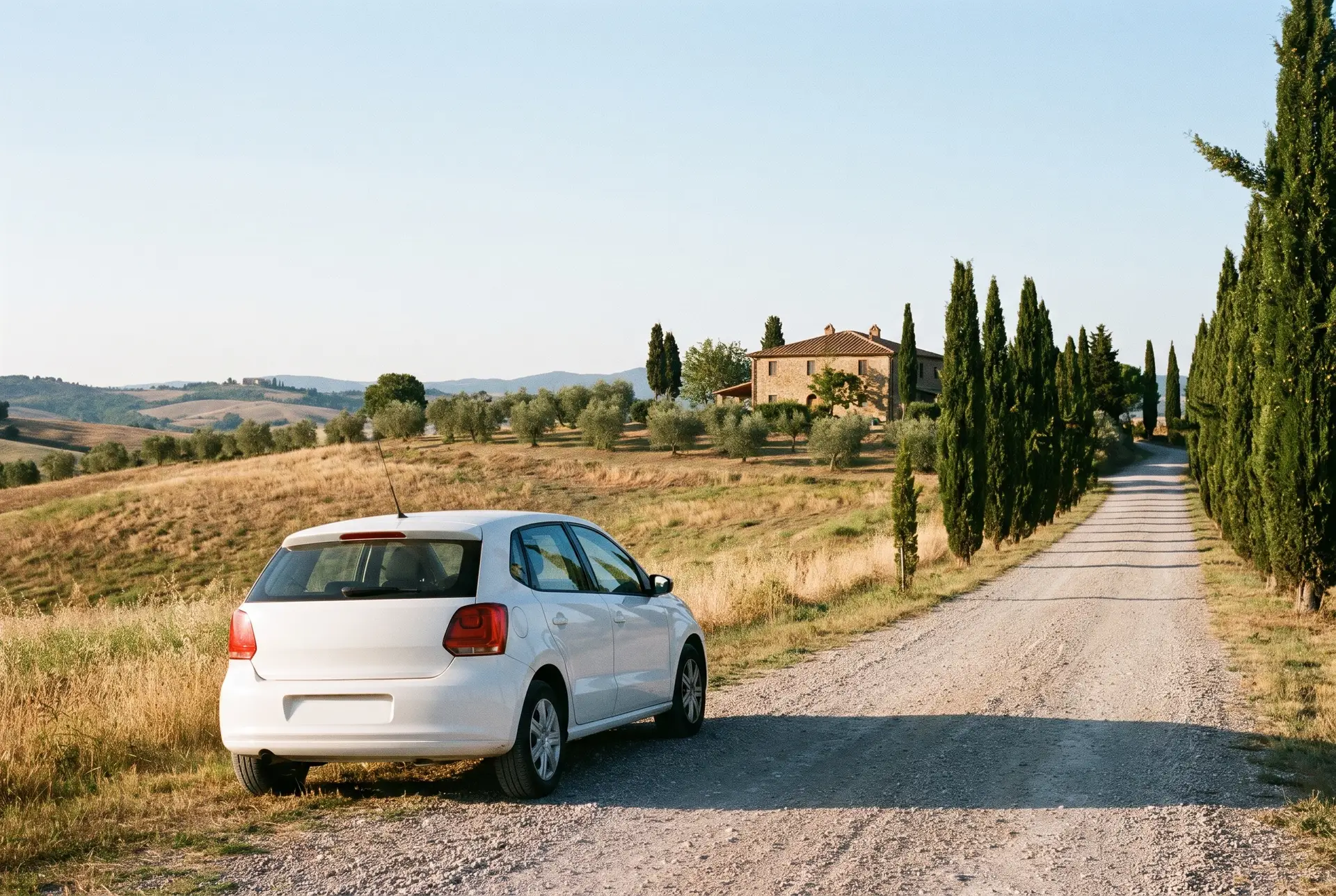
 Image generated by AI
Italy
Car hire in Italy
From €4 a day on a 7-day rental and from €5 for a single day, as of November 5, 2026: seven cities, airports and stations, delivery to your address. Most cars come with a deposit, shown on the listing. Below: how to avoid a ZTL fine.
from €4 per day on a 7-day rental
from €5 for a single day, as of November 5, 2026
Search and book
A live catalogue with prices and availability for your dates. You pay part of the total when you book and the rest on collection. Your rental contract is with the rental company.
Ad · companies may pay Roamo for referrals
Do you need a car in Italy?
Not always. On a week in Rome or Milan a car will sit in a paid car park: ZTL zones close off the centres, and trains and buses run in from the airports, among them the Leonardo Express, Malpensa Express, Alibus and Pisa Mover. Naples is the same, only with narrower streets.
A car pays for itself where public transport does not reach or runs rarely: Tuscany, the Amalfi Coast, Sicily and Sardinia. A good pattern is a few days in the city without one, then a car from the day you leave, which spares you the parking bills and the risk of a ZTL fine.
How much does car hire cost in Italy?
Car hire in Italy starts from €4 a day on a 7-day rental and from €5 for a single day, as of November 5, 2026; most cars come with a deposit, and the amount is shown on the car’s listing. The price depends on the season, the city and the car class, and each city has its own starting price: see Rome, Milan, Naples, Catania, Palermo, Pisa and Olbia.
There are fewer cars on offer than you might expect, and in Olbia out of season there may be none at all. We have no reliable prices by month, so we do not compare summer with winter. The company works out the exact amount for your dates.
Demand is high from May to September and peaks in August, with December and January the quietest months. Book early for the summer, especially an automatic. You pay 15–20% when you book and the rest to the company on collection.
Where to collect a car: airports and cities
There are seven cities: Rome (FCO), Milan (MXP and LIN), Naples (NAP), Catania (CTA) and Palermo (PMO) on Sicily, Olbia (OLB) on Sardinia and Pisa (PSA) in Tuscany. The handover differs from one airport to another: in Rome the offices are in a separate building, in Naples the rental area is 700 m from the terminal with a free shuttle, and in Palermo the offices are in the arrivals hall.
You can collect at the airport, at an office or by delivery where the company offers it. Termini, Catania Centrale and Palermo Centrale stations are options too. A company’s own office is the cheapest choice, with no delivery charge. Returning the car in another city costs extra.
The minimum rental is 24 hours, and a part day counts as a full one. Rental days run by the clock, so return the car at the same hour you collected it.
What is a ZTL and how do you avoid the fine?
ZTL stands for Zona a Traffico Limitato: a restricted zone in a historic centre, found in almost every old town in Italy and the main trap for drivers from abroad. A camera reads your number plate, nobody stops you and the sign is easy to miss. The fine is €83–332, or 30% less if you pay within 5 days.
With a hire car the notice goes to the company. It passes on your details and adds its administration fee, and the fine itself follows separately, often months later. The size of the fee depends on the company and is set out in the contract.
If your hotel is in the centre, give it your registration number in advance and wait for confirmation: the hotel adds it to the city’s list, and it will not get there by itself. Otherwise park at the edge of the zone and walk. The electronic sign at the entrance shows whether the camera is on: “Varco attivo” means do not enter.
Every city has its own rules. Rome: the Centro Storico and Tridente run by day and there are night zones too, so check the signs. Milan: entry to Area C by ticket, €7.50 a day, on weekdays from 7:30 to 19:30. Palermo: a €5 day pass. Naples: six zones and no permits for visitors. Pisa and Catania: hours depend on the area, so go by the sign at the entrance. Prices as of 1 November 2026.
What you need to hire a car: documents, age, deposit, insurance
A passport, your driving licence and a bank card. The licence must be the original and valid until the end of the rental; copies and digital licences are not accepted. A UK photocard licence is valid in Italy without an International Driving Permit, but the rental terms ask for an IDP alongside your licence, so ask the company. An old paper licence needs updating or an IDP, and an Isle of Man licence needs an IDP. An Irish or other EU licence needs no IDP by law. Age is usually from 21–23 with at least a year’s driving; the exact terms are on the car’s listing.
Most cars carry a deposit, shown on the listing, and some can be hired without a credit card, which you can see when booking. Where a card is needed, it must be a physical card with raised numbers in the main driver’s name; virtual cards do not work. Basic cover is included and extended cover depends on the car; standard cover excludes wheels, the underside, the windscreen and the interior. What the letters in the contract mean is explained in Insurance and deposit: what the letters mean — written for Montenegro, but the system is the same.
Before you go: entry, phones and money for UK and Irish travellers
Italy is in the EU and Schengen. UK passport holders can stay up to 90 days in any 180 without a visa. The EES has been fully running since 10 April 2026, and the relaxations for long queues ended on 6 September 2026, so you give biometric data at the border instead of getting a passport stamp. ETIAS has not started and no applications are being taken: the EU has dropped its “last quarter of 2026” date and named no new one, and sites offering to take your application now are unofficial. The fee will be €20. Check again before you travel. Irish citizens are EU citizens and need only a passport or ID card.
Since Brexit, roaming at home prices is not guaranteed on UK SIM cards: it depends on your network, so check your plan. Irish and other EU SIM cards roam at home prices. Your phone, with its country code, needs to work throughout the rental, as that is how the company reaches you. Signal can drop out in the mountains, so download offline maps.
The currency is the euro. Italy is one hour ahead of the UK and Ireland. Road signs use the international symbols, but any wording is usually in Italian: worth knowing are “Uscita” (exit), “Self” or “Fai da te” (self-service pumps), “Servito” (attendant service) and “Varco attivo” (ZTL camera on). The emergency number is 112.
Taking a hire car abroad, on ferries and on dirt tracks
You can usually take a hire car to France, Switzerland, Austria or Slovenia, but only if the company has agreed in advance. Tell it before you book: it will prepare the paperwork and may charge extra. In this Italy differs from Greece, where you cannot leave the country at all. Switzerland, Austria and Slovenia require a vignette, which an Italian car usually does not have, so you buy your own. The Swiss one costs CHF 40 and is valid until 31 January 2027; Austria’s 2026 prices are €9.60 for one day and €12.80 for 10 days; Slovenia’s is €16 for 7 days. Prices as of 1 November 2026.
A hire car can go on a ferry only with the company’s agreement, so arrange this when you book. Basic cover does not usually include damage on board. For Sicily and Sardinia it is simpler to fly and collect a car there, and for Capri, Ischia and Procida leave the car behind. There is no bridge over the Strait of Messina: the Villa San Giovanni–Messina ferry runs round the clock, takes about 20 minutes and costs €43.60 one way for a car and passengers as of 1 November 2026.
Hire cars may only be driven on tarmac. If a beach is at the end of a dirt track, leave the car before it starts: on unsurfaced roads the insurance does not apply.
Driving in Italy: speed limits, alcohol and fines
Italy drives on the right and you overtake only on the left. In towns the limit is 50 km/h, often 30 in historic centres; outside towns it is 90, on expressways (“extraurbane principali”, which are dual carriageways) 110 and on motorways 130. In rain or snow it drops to 90 on expressways and 110 on motorways. With under three years’ driving experience the limits are 90 on expressways and 100 on motorways. There are plenty of cameras, and on motorways they measure your average speed as well.
The usual alcohol limit is 0.5 g/l, but it is zero if you are under 21 or in your first three years of driving. Keep your lights on outside built-up areas. Children under 1.50 m travel in a child seat or booster. Check that the car has a reflective vest and a warning triangle.
Fines are high: holding a phone from €250 plus a ban of at least 15 days, more than 10 km/h over the limit from €173, a red light from €167, no seatbelt from €83 and alcohol above 0.5 g/l from €543. Pay within 5 days and the fine is 30% less, unless it comes with a ban.
Tolls, parking and petrol
Ordinary roads in Italy are free. You pay on the motorways (“autostrade”), which have an A in their number and green signs, by card or in cash when you leave. The calculator on the Autostrade per l’Italia website gives the fare for your route. On Sicily, Catania–Messina costs €3.80 and Palermo–Messina €10.40 as of 1 November 2026. Palermo–Catania and the whole of Sardinia are free. There are no vignettes. Stay out of the Telepass lanes, which are for transponders. If a payment fails at the booth you get a slip, and you have 15 days to pay the operator online.
Near Milan, the A36 motorway has no barriers: cameras read your plate and you have 15 days to pay. Ask the company how this works on your car.
Blue lines are paid, white lines are free and yellow lines are off-limits. The sign alongside gives the price and hours. Central Milan costs €3 an hour for no more than two hours; Catania and Palermo are about €1. Prices as of 1 November 2026.
On 14 October 2026 the ministry’s national average was €2.04 a litre for petrol and €2.25 for diesel, so diesel is the dearer fuel here. A 45-litre tank of petrol comes to about €92. Fuel costs more on motorways, and Self pumps are cheaper than Servito. On Sardinia and in rural areas fill up in good time, as some stations close during the day and at weekends.
Where to go with a hire car
From Rome: Lake Bracciano (40 km) and Orvieto (121 km). From Milan: Lake Como (52 km), Bergamo (54 km) and Verona (156 km). From Naples: Pompeii (25 km), Caserta (33 km), Sorrento (48 km) and Amalfi (61 km). From Pisa: Lucca (17 km), Florence (100 km) and Siena (121 km).
On Sicily, from Catania: Etna, Taormina (55 km), Syracuse (67 km) and Agrigento (158 km); from Palermo: Monreale (10 km), Mondello (15 km) and Erice (113 km). On Sardinia, from Olbia: Porto Cervo (about 35 km from the airport) and Alghero (137 km). For the mountains — Vesuvius, Etna, the Amalfi hairpins — take something with more power; in Italian towns a small car is easier, given the narrow streets and tight parking.
What can go wrong
A ZTL fine can arrive months after you get home, so read up on the zones before you drive. After a breakdown or accident, tell the company straight away and get a police report, or the cover is void. If the car breaks down, the company must give you one of the same or a higher class on the same terms. A no-show counts as a late cancellation, and you lose the prepayment.
From 15 November to 15 April, parts of the mountain road network require winter tyres or chains in the car, so before heading for the Alps, the Apennines or Etna, ask the company what is fitted to yours. In season, the Amalfi Coast road takes cars by odd and even number plates, so check the order for your dates.
Fines, parking, tolls and fuel are the renter’s to pay. To compare how this works elsewhere, see car hire in Croatia and in Montenegro.
Good to know
Seven cities
Rome, Milan, Naples, Catania, Palermo, Olbia and Pisa: at the airport, the station, an office or by delivery where the company offers it.
The terms before you pay
Deposit, insurance, mileage limit and card requirements are on the car’s listing before you book.
ZTL warnings
The city pages explain how the zones work, how to give your hotel the registration number and where to leave the car.
How it works
Pick dates and a class
See what is free on your dates and compare price, deposit and insurance.
Book with the rental company
15–20% when you book, the rest on collection. Planning a trip abroad or a ferry? Agree it with the company in advance.
Collect the car
At the airport, an office or by delivery. If your hotel is in a ZTL, give it the registration number straight away.
Conditions
- Licence
- The original licence, valid until the end of the rental; copies and digital licences are not accepted. An International Driving Permit is worth carrying too: a UK photocard licence is valid without one, but ask the company. You also need a passport and a bank card.
- Age and experience
- Usually from 21–23 with at least a year’s driving. The exact terms are on the car’s listing, and they differ even between identical models.
- Deposit
- Most cars carry a deposit, shown on the listing. Some can be hired without a credit card, which you can see when booking. Where a card is needed, it must be a physical card in the main driver’s name; virtual cards do not work.
- Insurance
- Basic cover is included; extended cover depends on the car. Standard cover excludes wheels, the underside, the windscreen and the interior. After an accident, tell the company straight away and get a police report, or the cover is void.
- Borders and ferries
- Usually allowed to France, Switzerland, Austria and Slovenia, but only if the company has agreed in advance, and it may charge extra. Ferries only with the company’s agreement; basic cover does not usually include damage on board.
- Fuel
- Return the car with the same fuel level as at collection. Any shortfall is charged at the company’s rate; extra fuel is not refunded.
- Season
- Demand for hire cars is high from May to September and peaks in August, with December and January the quietest months, so book early for the summer, especially an automatic. Sicily is easiest in spring and early autumn, and Sardinia outside the summer: the sea is still warm in September. Some places on the coast close for the winter. From 15 November to 15 April, parts of the mountain road network require winter tyres or chains in the car.
By city
Common questions
How much does car hire cost in Italy?
From €4 a day on a 7-day rental and from €5 for a single day, as of November 5, 2026. Most cars come with a deposit, and the amount is shown on the car’s listing. The price depends on the season, the city and the car class, and each city page gives its own starting price. The company works out the exact amount for your dates.
How do I avoid a ZTL fine?
Park at the edge of the zone and walk. If your hotel is in the centre, give it your registration number in advance and wait for confirmation: the number does not get onto the city’s list automatically. The fine starts at €83, and the company adds its administration fee.
Do I need an International Driving Permit?
With a UK photocard licence or an Irish or other EU licence, not by law, but the rental terms ask for one alongside your licence, so check with the company. An old paper UK licence needs updating or an IDP, and an Isle of Man licence needs an IDP. Originals only.
What kind of card do I need?
For cars that require a credit card, it must be a physical card with raised numbers in the main driver’s name; virtual cards do not work. A debit card is accepted only where the voucher says so. Some cars can be hired without a credit card, which you can see when booking.
Can I drive a hire car to Switzerland or France?
Usually, but only if the company has agreed in advance. Tell it before you book: it will prepare the paperwork and may charge extra. Switzerland, Austria and Slovenia require a vignette, which an Italian car usually does not have.
Can I take a hire car on a ferry?
Only with the company’s agreement, arranged when you book. Basic cover does not usually include damage on board. For Sicily and Sardinia it is simpler to fly and collect a car there; leave the car behind altogether for Capri, Ischia and Procida.
How do I cancel a booking?
Free up to 7 days before the rental starts, or 30 days for convertibles and luxury cars; with the free cancellation option, up to 24 hours before. A 6% payment fee is kept, and the prepayment is refunded within 14 days.
What are the speed limits in Italy?
In towns 50 km/h, often 30 in historic centres; outside towns 90, on expressways 110 and on motorways 130. In rain or snow it drops to 90 on expressways and 110 on motorways. With under three years’ driving experience the limits are 90 and 100.