Georgia road trip: Tbilisi, Kazbegi, Kutaisi, Batumi
Updated:
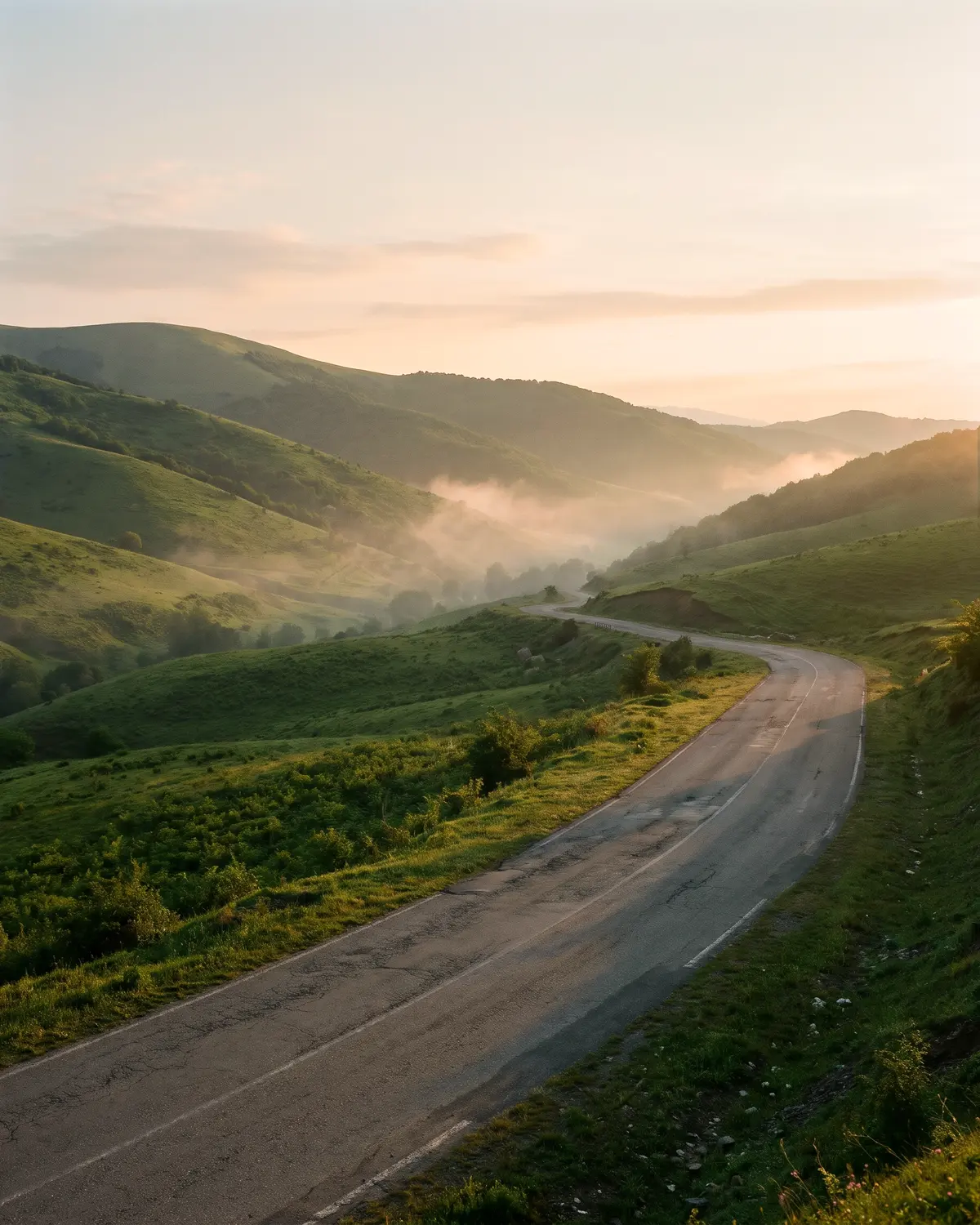 Image generated by AI
The route runs Tbilisi–Mtskheta–Ananuri–Stepantsminda–Uplistsikhe–Kutaisi–the canyons–Batumi. It takes seven days and covers roughly 600 km on the main roads, plus side trips. All of it is on tarmac, so an ordinary car with an engine of at least 1.6 litres will do.
You collect the car in Tbilisi and return it in Batumi. That is allowed, though the price includes delivery to wherever the company has no office. The season for this trip is May to October.
If you are still placing Georgia on the map, Tbilisi is in the east, Batumi is on the Black Sea in the west, and the two are 350–370 km apart. Stepantsminda, also known as Kazbegi, lies in the mountains to the north, close to the Russian border. The flat highway west goes quickly, but mountain sections, overtaking and stops at monasteries eat up time, which is why no day on this route has you driving in the dark.
How does the route work?
| Day | Stage | Distance and time without stops |
|---|---|---|
| 1 | Tbilisi | arrive, explore the city on foot |
| 2 | Tbilisi–Stepantsminda | 145–155 km, 2.5–3 hours |
| 3 | Stepantsminda, Gergeti, Gveleti | short trips, up to 7 km |
| 4 | Stepantsminda–Uplistsikhe–Kutaisi | 290–330 km, 4–4.5 hours |
| 5 | Gelati, Sataplia, Prometheus Cave | 10–22 km from Kutaisi |
| 6 | The canyons, then Kutaisi–Batumi | an hour to the canyons, about 150 km to Batumi |
| 7 | Gonio or the botanical garden, fly home | 9–15 km from Batumi |
The order is deliberate. For a hire car the Kazbegi road is a dead end, since the border lies beyond it and you cannot cross. So the mountains come first, and you work your way down to the sea.
You can drive the whole thing in reverse, but then the long stretch from Kutaisi comes just before the mountains, and you reach the pass tired.
What car should you hire?
For the Tbilisi–Kutaisi–Batumi highway an economy car is enough. For the mountains, go for an engine of at least 1.6 litres. A crossover usually costs only a little more than a saloon. Four-wheel drive is not essential on this route, although a crossover is more comfortable on the climb to Gergeti.
Cars in Tbilisi start from $22 a day (as of 1 November 2026). Across the country the average day costs $33–43 depending on the month: January to March is cheapest, July and August dearest. The exact amount for your dates is calculated by the rental company, and the terms are on the car rental in Georgia page.
Check the insurance terms too. Basic cover leaves out the wheels, underbody, windscreen and interior, which matters in the mountains, so look at the terms of the specific car before you pay.
Day 1: Tbilisi without a car
Fly into Tbilisi and see the city on foot: the Old Town is better without a steering wheel, and parking in the centre is paid. Unless you are leaving straight from the airport, have the car brought to your hotel on the morning of day 2. How the handover works and what to do in your first hours are covered in our guide to car hire at Tbilisi airport.
If your flight lands at night, you need that first night in the city even more: the mountains are no place to go after a sleepless night.
Day 2: Tbilisi to Stepantsminda via Mtskheta
This is the main drive of the trip. Set off in the morning and give it the whole day.
Mtskheta. The first stop is 20–25 km from Tbilisi, about half an hour away. Jvari Monastery, Svetitskhoveli Cathedral and Samtavro Monastery are on the UNESCO list as the Historical Monuments of Mtskheta, inscribed in 1994. Jvari stands on a hill above the meeting of two rivers, with the whole town visible below.
Ananuri. A fortress on the Zhinvali reservoir, about 65 km from Tbilisi. It makes a good short stop to stretch your legs, as the road starts to climb from here.
Gudauri and the viewpoint. A ski resort at around 2,200 m. Beyond it the road reaches a viewpoint over the Devil’s Valley and then the Jvari Pass, also called the Cross Pass, at almost 2,400 m.
Stepantsminda. A village below Mount Kazbek, 145–155 km and 2.5–3 hours from Tbilisi without stops. With stops it takes up the day. The road is described in detail in Kazbegi by car.
What to bear in mind. Locals often overtake on blind bends, sometimes two at a time. Keep right and take your time. The phone signal drops out in the mountains, so download offline maps in Tbilisi, and fill up before the climb.
Day 3: Gergeti and around Stepantsminda
Gergeti Church stands on a hill above the village, about 6 km away. The road is tarmac but steep on the upper section, where a crossover is more comfortable. You can also walk: 6.4 km there and back, about 2.5 hours.
Gveleti waterfalls are 7 km north of the village, with a path of 4 km there and back from the road.
Where you can’t go. In a hire car you can only go up the Truso valley as far as Almasiani. Sno is fine, but the road beyond it to Juta is not: it is unsurfaced and the insurance does not apply. People carry on with local drivers in 4x4s.
If the weather turns you can shorten the day. Gergeti loses half its point when you cannot see anything, and a second night in the mountains gives you some slack if the road closes.
Day 4: Stepantsminda to Kutaisi via Uplistsikhe
This is the longest drive: 290–330 km, 4–4.5 hours without stops. You first go back down the Georgian Military Road to Mtskheta, then take the highway west. Leave in the morning.
Uplistsikhe. A cave town on a rocky hillside, about 10 km from Gori. It is 80–85 km from Tbilisi, so for you it means turning off the highway and coming back. Opening hours differ between sources, so check them before you go. Allow 1.5 to 2.5 hours for a visit. There is little shade, so in summer take water and a hat.
The Rikoti road. Next comes the new four-lane road over the Rikoti Pass: 52 km with 51 tunnels and 97 bridges, open to traffic since 30 December 2025. It has shortened the journey west, and Tbilisi–Kutaisi is now about 230 km and 3–4 hours. Watch your speed, because there are a lot of cameras. In winter, winter tyres are compulsory on part of this stretch.
Kutaisi. A city of around 180,000 people. It suits a two-night stay, since it is easier to see the area from one base.
Day 5: Gelati, Sataplia and Prometheus Cave
Kutaisi justifies having a car sooner than anywhere else, because buses do not reach many of the places around it.
Gelati Monastery. About 11 km from the city. Founded in 1106 by David the Builder and on the UNESCO list since 1994. Restoration work is under way and part of the complex may be closed, so check the current position before you go.
Sataplia. A nature reserve about 10 km from Kutaisi, with dinosaur footprints, a karst cave and a glass viewing platform.
Prometheus Cave. 20–22 km from Kutaisi, at the village of Kumistavi. The route is 1,420 metres long, takes about an hour and passes through six halls. In spring, summer and autumn you can finish by boat on the underground river, which is paid for separately. The official site says the cave opens daily, but travel guides mention Mondays off, so check the hours on the cave’s page.
You can fit all three in, but do not rush. Confirm the opening hours and start with the furthest.
Day 6: the canyons and the road to the sea
Okatse and Martvili canyons, Kinchkha waterfall. About an hour’s drive from Kutaisi, with Martvili about 45 km away, on excellent tarmac and with car parks. At Martvili you pay for entry and for the boat separately, and boats can be cancelled after heavy rain.
The road to Batumi. About 150 km and 2–2.5 hours from Kutaisi. Thick fog can settle on the E70 and around Ureki. In July and August, traffic around Kobuleti adds an hour on Saturdays from 10:00 to 14:00 and Sundays from 16:00 to 21:00.
On the way you could turn off to Kobuleti, with 12 km of pebble and sand beach and quiet streets. Batumi is 25–30 minutes from there. If the day looks too long, move the canyons to day 5 and drop the cave.
Day 7: Batumi
One short trip is enough before your flight.
Gonio Fortress. 12–15 km south, 20–30 minutes. A Roman fortress, and one of the oldest on the Black Sea coast.
Batumi Botanical Garden. About 9 km north of the centre, at Green Cape. Entry is paid, so check the hours and prices before you go.
Makhuntseti waterfall and Queen Tamar’s arched bridge. About 30 km, 40–50 minutes, and an option if you have an extra day. The waterfall is about 30 m high and the bridge is 2 km from it. After the village of Keda the road winds, and an engine of at least 1.6 litres helps.
You can return the car at Batumi airport (BUS), at the company’s office or at your hotel. Parking by the sea and in the Old Town is paid, so look for accommodation with its own parking. Leaving the car in Batumi is easier than driving back to Tbilisi, which is 350–370 km and 4.5–6 hours.
Where can’t you take a hire car?
Learn these before you set off. On these routes the insurance does not apply, and you are liable for any breakdown.
- The Goderdzi Pass between Batumi and Akhaltsikhe. Sat nav often sends you this way. Go via Kutaisi instead: Akhaltsikhe–Borjomi–Kutaisi–Batumi.
- Tusheti, Shatili, Juta, and Truso beyond Almasiani. People go there with local drivers in 4x4s.
- Mestia–Ushguli–Lentekhi. This stretch is open to hire cars only with a special option, and only from May to September, so ask when booking.
- Abkhazia and South Ossetia. You cannot go there in a hire car: these territories are not controlled by the Georgian authorities, and the insurance does not apply.
- Abroad. Not to Turkey, Armenia or Azerbaijan, even for an extra fee.
Details are in our guide to borders and restricted roads.
What changes in winter?
From 1 December to 1 March winter tyres are compulsory on sections chosen by the government, including Mleta–Kobi and part of the highway near the Rikoti Pass. The Jvari Pass sometimes closes for a day or two in winter, so leave a margin before your flight home. Hire is roughly a quarter cheaper in winter than in summer, but this is the time to shorten the route: without Kazbegi it is simpler and more reliable.
What if you have more or fewer days?
Five days. Drop day 1 in Tbilisi and day 5 around Kutaisi, keeping only Gelati on the way to the sea. It is a tight schedule, but you still see the mountains and the sea.
Nine or ten days. Add Kakheti at the start. Telavi is about 95 km and 1.5–2 hours from Tbilisi. Signagi is about 110 km, roughly 2 hours. Between the two it is about 63 km, just over an hour. For the wineries you need someone who is not drinking, as the limit is only 0.3 per mille.
Svaneti. The road to Mestia goes via Zugdidi and Jvari. This is a separate long trip from the west of the country, and you should check the rental terms for it in advance.
Who is this route not for?
If you only want Tbilisi, Kutaisi and Batumi and plan to walk around each city, you can manage without a car, as public transport runs between the main cities. If you dislike mountain roads, start in the west: the tarmac around Kutaisi is good, and you can reach Kazbegi by minibus.
When you get tired, cut the day short. A missed monastery costs less than a hairpin road in the dark.
Hire prices are as of 1 November 2026; road conditions and distances in November 2026. Opening hours change with the seasons and have not been confirmed for every stop, so check them before you go.
Common questions
How many days do you need for a road trip in Georgia?
Seven days is enough for Tbilisi, Kazbegi, Kutaisi and Batumi without driving at night. In five days you can only manage the main stops.
Can I collect a car in Tbilisi and return it in Batumi?
Yes. The price then includes delivery to wherever the company has no office, and you see the amount when booking.
How long is the drive from Kazbegi to Kutaisi?
About 290–330 km, or 4–4.5 hours without stops. With Uplistsikhe and lunch it fills the whole day.
Do I need a 4x4 for this route?
No. The whole route is on tarmac, but take a car with an engine of at least 1.6 litres for the mountains, and a crossover is more comfortable.
Can I drive from Batumi to Akhaltsikhe over the Goderdzi Pass?
No, the pass is banned for hire cars. Sat nav often suggests it, but you need to go via Kutaisi.
When is the best time for this route?
May to October. From 1 December to 1 March winter tyres are compulsory on mountain sections, and the pass on the way to Kazbegi can close.