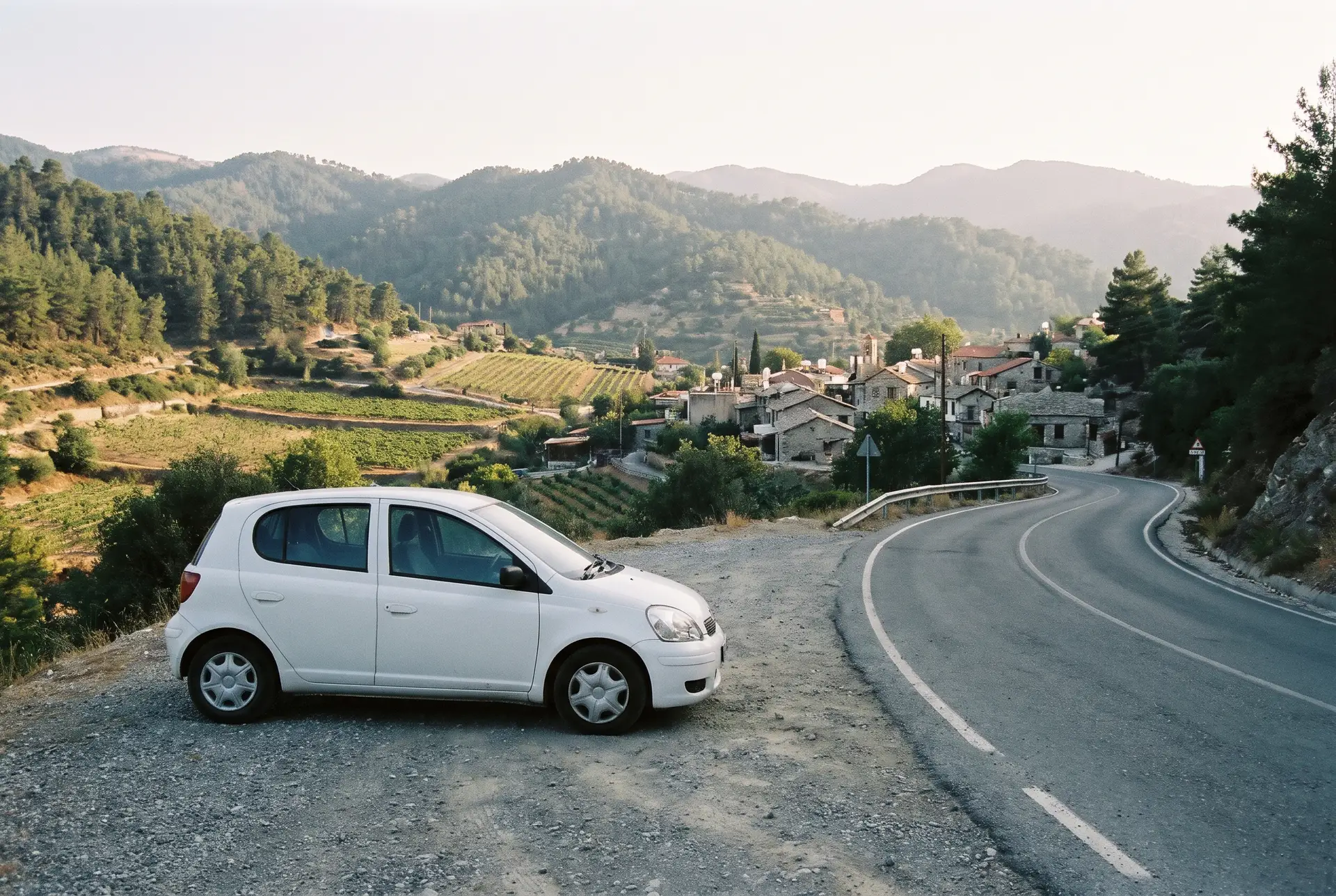
 Image generated by AI
Cyprus
Car rental in Cyprus
From €12 a day on a 7-day rental and from €20 for a single day, as of November 1, 2026: Larnaca and Paphos airports, hotel delivery, and about a third of cars with no deposit.
from €12 per day on a 7-day rental
from €20 for a single day, as of November 1, 2026
Search and book
A live catalogue with prices and availability for your dates. You pay part of the total when you book and the rest on collection. Your rental contract is with the rental company.
Ad · companies may pay Roamo for referrals
Do you need a car in Cyprus?
Not everyone does. If you are flying in for a week at a beach hotel in Ayia Napa or Limassol and will not go beyond the seafront, the car will sit in the car park. Buses run between towns, and a shuttle links Larnaca Airport with Nicosia.
But the island is small and well served by good roads: Larnaca to Paphos takes an hour and a half to two hours, Nicosia and Ayia Napa are 40–50 minutes. With a car, one holiday is enough for the Troodos mountains and their monasteries, Cape Greco and Petra tou Romiou, places that take a long time to reach by bus.
Traffic keeps left, with the steering wheel on the right. For UK and Irish drivers that is simply home; drivers from the Netherlands or Scandinavia who have never done it should take an automatic and full insurance rather than give up on a car.
How much does car hire in Cyprus cost?
The lowest price is from €12 a day on a 7-day rental and from €20 for a single day, as of November 1, 2026. Winter, January to March, is the cheapest time; prices rise in April, stay high from May to October and peak in July, at nearly twice the winter rate. October is still high season in Cyprus, about the same as September; prices only fall noticeably in November and December.
Towns differ on a 7-day rental: Larnaca from €12 with the most cars, Paphos from €17, Limassol from €22, Ayia Napa from €24 and Nicosia from €25. In summer Limassol and Ayia Napa are dearest.
Prices depend on the class and the season and are calculated by the company. Most cars come with unlimited mileage; where there is a limit, it is stated in the description.
Which airport should I pick up from: Larnaca or Paphos?
The island has two airports. Larnaca (LCA) is the main one, about 5 km from the centre and closest to Nicosia, Ayia Napa and Limassol. Paphos (PFO) is in the west, about 20 minutes from town. At both, the car is usually handed over outside the terminal in the car park, and the agent messages you the day before.
Limassol, Ayia Napa and Nicosia have no airport of their own: you collect at the airport on arrival or have the car brought to your hotel or a town office. You can return it in another town or airport, for example flying into Larnaca and out of Paphos; the terms and any extra charge are on the car's listing.
What do I need to hire a car in Cyprus?
You need a passport, a driving licence and a bank card, plus the voucher, on your phone or printed out. The licence must show your details in Latin script and be valid until the end of the hire; UK and EU licences need no International Driving Permit. Age and experience depend on the car: most often 25 with 3 years' driving, some from 21 with a surcharge.
You pay 15–20% online and the rest on collection. About a third of cars come with no deposit; for the rest it is usually up to €300. Free cancellation is up to 7 days before pick-up, or up to 24 hours with the free cancellation option.
Basic insurance is usually included but does not cover tyres, the underside, the windscreen or the interior. If you are not used to driving on the left, take full cover for the first days. The one firm restriction: a hire car cannot be driven to the north of the island, where the insurance is not valid.
What British and Irish visitors should know before they go
UK citizens need no visa and can stay up to 90 days in any 180. Cyprus is not in the Schengen area, so days here do not count towards the Schengen 90/180, and the EU Entry/Exit System is not in use here while that remains the case. Check the passport validity rules on gov.uk before you travel.
Irish, Dutch and Nordic travellers are in the EU, and so is Cyprus, so an EU SIM roams at home rates; there are still passport checks because Cyprus is outside Schengen, with joining expected in 2027. UK SIMs follow your own operator's roaming terms. The currency is the euro.
Greek is the official language, but English is widely spoken and road signs are in both Greek and English.
Roads, speed limits, parking and fuel
There are no toll roads or vignettes in Cyprus. The roads are good and signs are repeated in English. Limits are in km/h: 50 in towns, 30 in places, 80 outside towns and 100 on the motorway. With the engine running you may not hold a phone, a coffee or a bottle of water: a phone in your hand or an unfastened seatbelt costs from €150, a coffee at the wheel €85 and a red light €300. The alcohol limit is about 0.5 per mille, and close to zero for drivers with under three years' experience; the safe choice is not to drink at all.
Parking is cheap: usually €0.50–2 an hour in town centres, meters mostly take coins, and evenings and weekends are often free, so read the sign. Park only in the direction of traffic, or face a €100 fine, and never on a yellow line; an expired meter costs €8.
In autumn 2026 petrol costs around €1.76 a litre and diesel around €2, so a 45-litre tank is around €80, much the same as in Montenegro. The reduced fuel duty runs until 30 November 2026, after which prices may rise. Paying by card at the pump blocks around €60, so pay in cash where you can. Prices checked in October 2026.
Where to go in a hire car
The classic route follows the coast from west to east: Paphos with its mosaics and the Tombs of the Kings, Petra tou Romiou, Limassol, Larnaca with the Church of St Lazarus, and Ayia Napa with Nissi Beach and Cape Greco.
The second trip is into the Troodos mountains: Platres, Kykkos Monastery, Kakopetria. The roads are mountain roads, so you need an engine of 1.6 litres or more. In winter, roughly from December to February, there can be snow: the police close roads or allow only cars with chains and four-wheel drive. Check that the road is open and ask the company whether this car may go into the mountains.
What can go wrong with a hire car in Cyprus?
The most common mistake is a dirt track. Hire cars in Cyprus are for tarmac only: Akamas, Avakas Gorge, Lara Bay, the Blue Lagoon, the Adonis Baths and the dirt tracks around Cape Greco are off limits for every class of car.
The second is roundabouts, for anyone used to driving on the right: give way to traffic already on the roundabout, signal right as you go on and left as you come off. Your red plates mark you as a visitor and locals are used to that; driving is generally calm, though motorcyclists can be aggressive, so let them pass. After an accident or any damage, call the manager on your voucher at once and get a police report; do not arrange repairs yourself.
The third is camera fines: they reach the company with a delay and are taken from your deposit, or paid when you return the car if there is no deposit. What the letters in the insurance contract mean is explained in Insurance and deposit: what the letters mean; the rules there are for Montenegro, but the terms are the same.
Car or bus?
If you are staying in one town and only going as far as the next beach, buses and the airport shuttle will do. A shuttle runs from Larnaca Airport to Nicosia, town buses run in each town, and you can book a transfer to your hotel.
A car wins once your plans include the mountains, monasteries, distant beaches or crossing from one end of the island to the other. A day costs around €20 in winter, there are no tolls and parking is cheap, so for two or three people it is usually easier than piecing a trip together from buses. Start with the Cyprus page or go straight to your arrival town, Larnaca or Paphos.
Good to know
See the price before you pay
The catalogue shows the total for your dates before you pay, along with the deposit and rental terms.
No deposit if you prefer
About a third of cars come with no deposit, and some can be paid for in cash or by debit card.
Two airports
Larnaca and Paphos, handover at the terminal. In Limassol, Ayia Napa and Nicosia, town offices and hotel delivery.
How it works
Pick dates and a class
See what is available on your dates and compare prices, deposit and insurance.
Book with the rental company
15–20% online, the rest on collection. We never see or store your card details.
Collect the car
At the terminal, an office or your hotel: the agent messages you the day before with the meeting point.
Conditions
- Driving licence
- UK and EU licences are accepted without an International Driving Permit. The licence must show your details in Latin script and be valid until the end of the hire. Photocopies and digital licences are not accepted.
- Age and experience
- Each car has its own rules, shown on the listing. Most often you need to be 25 with 3 years' driving; some cars are available from 21 with a young driver surcharge.
- Deposit
- About a third of cars need no deposit; for the rest it is usually up to €300. Some cars require a credit card in the main driver's name, others can be paid for in cash or by debit card. This is shown when you book.
- Insurance
- Basic CDW or TLP is usually included and does not cover tyres, the underside, the windscreen or the interior. Full cover (SCDW) includes them. For any damage, call the company at once and get a police report.
- Northern Cyprus
- A hire car cannot be driven to the north of the island: the rental terms forbid it and the insurance is not valid there. No ferries are needed for trips around Cyprus, and you can return the car in another town.
- Fuel
- Return the car with the same level as at pick-up. Any shortfall is charged at the company's rate, and extra fuel is not refunded.
- Season
- Demand stays high from May to September and peaks in August; July is the most expensive month. For summer book a month or two ahead, because no-deposit cars go first. November to March is the cheapest time.
By city
Common questions
How much does it cost to hire a car in Cyprus?
From €12 a day on a 7-day rental and from €20 for a single day, as of November 1, 2026. January to March is cheapest; July costs nearly twice as much. On a 7-day rental Larnaca starts from €12, Paphos from €17, Limassol from €22, Ayia Napa from €24 and Nicosia from €25. The exact amount is calculated by the company.
Do I need an International Driving Permit with a UK licence?
No. UK and EU licences are accepted without one. The licence must be valid until the end of the hire and show your details in Latin script; photocopies and digital licences are not accepted.
Can I hire a car without a deposit or a credit card?
Yes. About a third of cars come with no deposit, and some can be paid for in cash or by debit card; both are separate filters. Other cars need a credit card in the main driver's name.
Can I drive to Northern Cyprus?
No. A car hired in the Republic of Cyprus cannot be driven to the north of the island: the rental terms forbid it and the insurance is not valid there.
How does pick-up at the airport work?
Some companies have a desk in the terminal, but more often an agent meets you outside and hands over the car in the airport car park. They message you the day before; their contact is on the voucher. For a night flight, give your flight number: some cars carry an out-of-hours charge.
When should I book a car for the summer?
A month or two ahead. Demand stays high from May to September and peaks in August, and no-deposit cars go first. November to March is the cheapest time.
Are there toll roads in Cyprus?
No, there are no toll roads and no vignettes. But a hire car stays on tarmac: the dirt tracks of Akamas, Avakas Gorge, Lara Bay, the Blue Lagoon and Cape Greco are off limits.